and the Algorithmic Universe
The Scripted Universe
There was a time when language measured the universe.
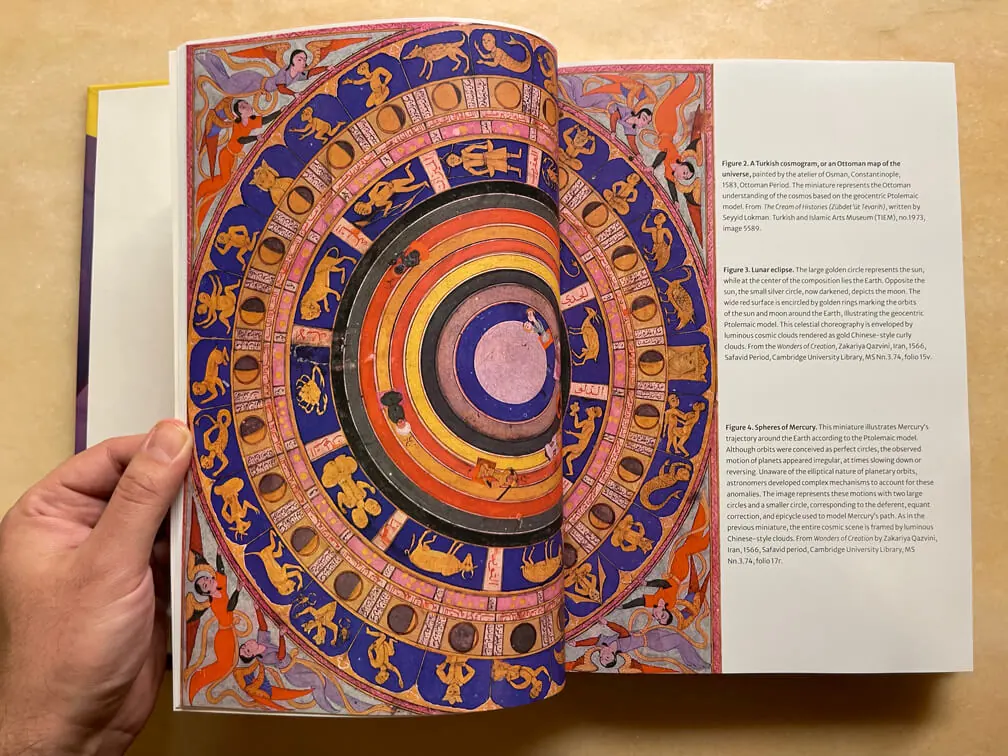
Long before machine code, we imagined a divine script with which the cosmos was written.
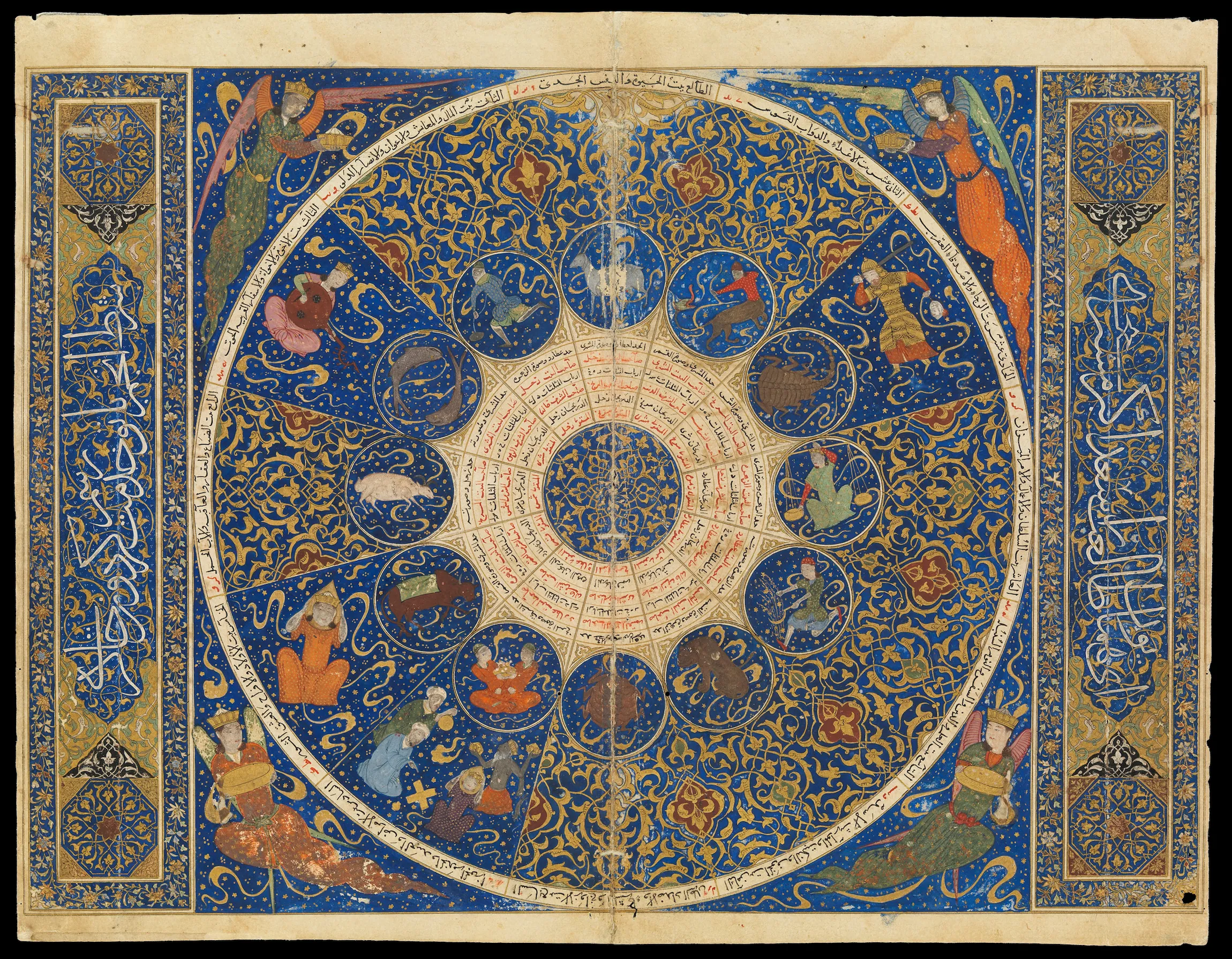
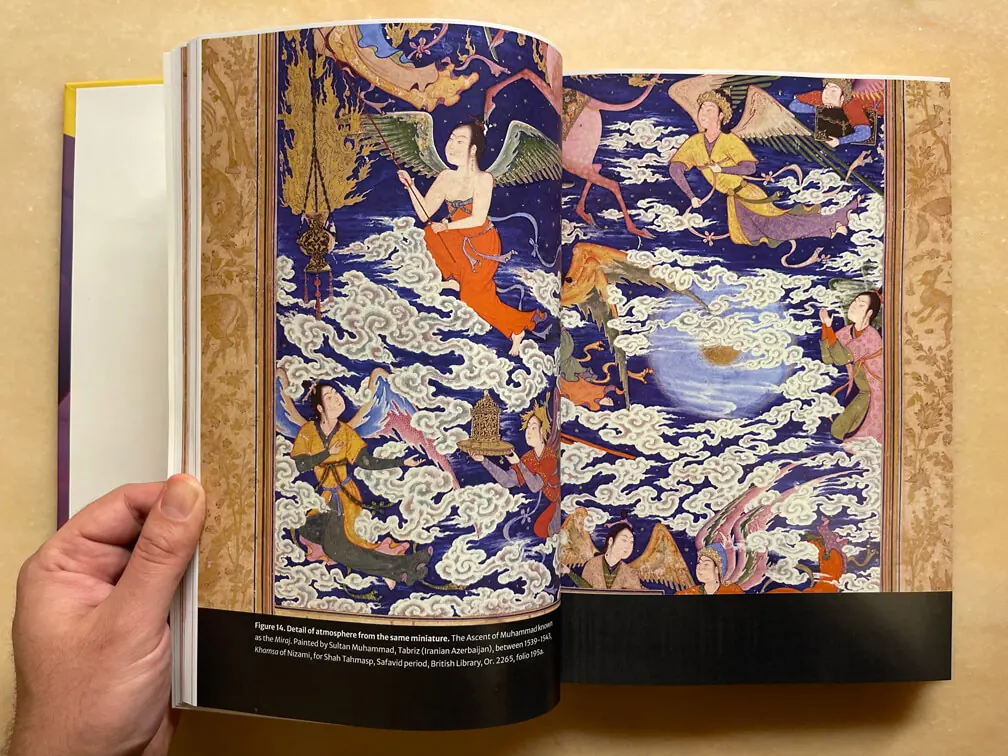
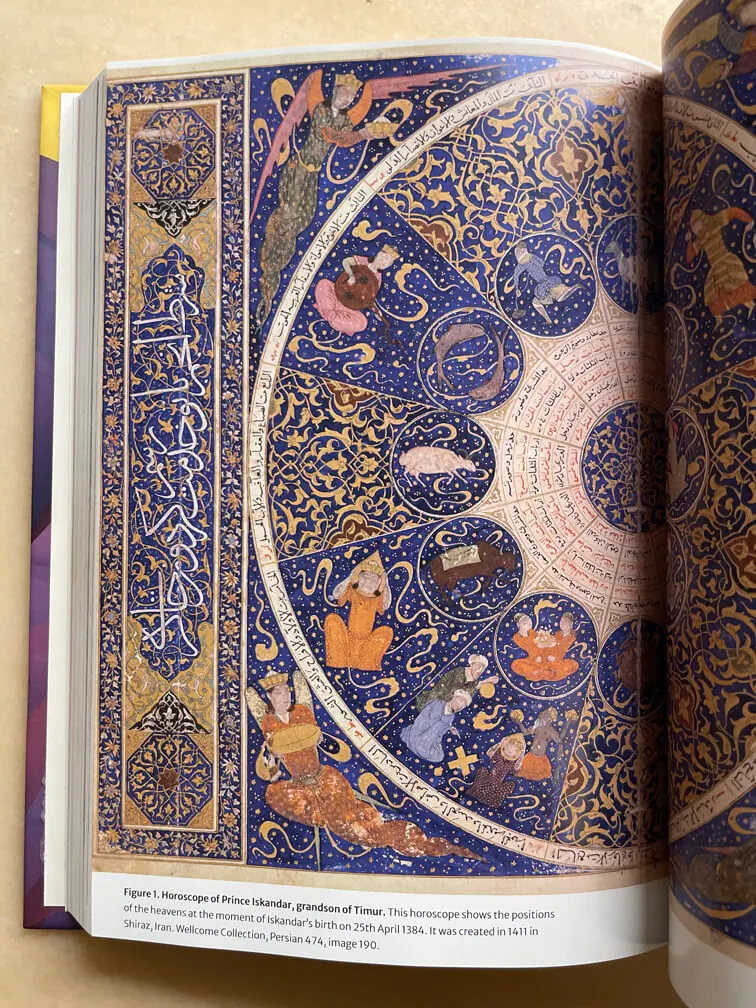
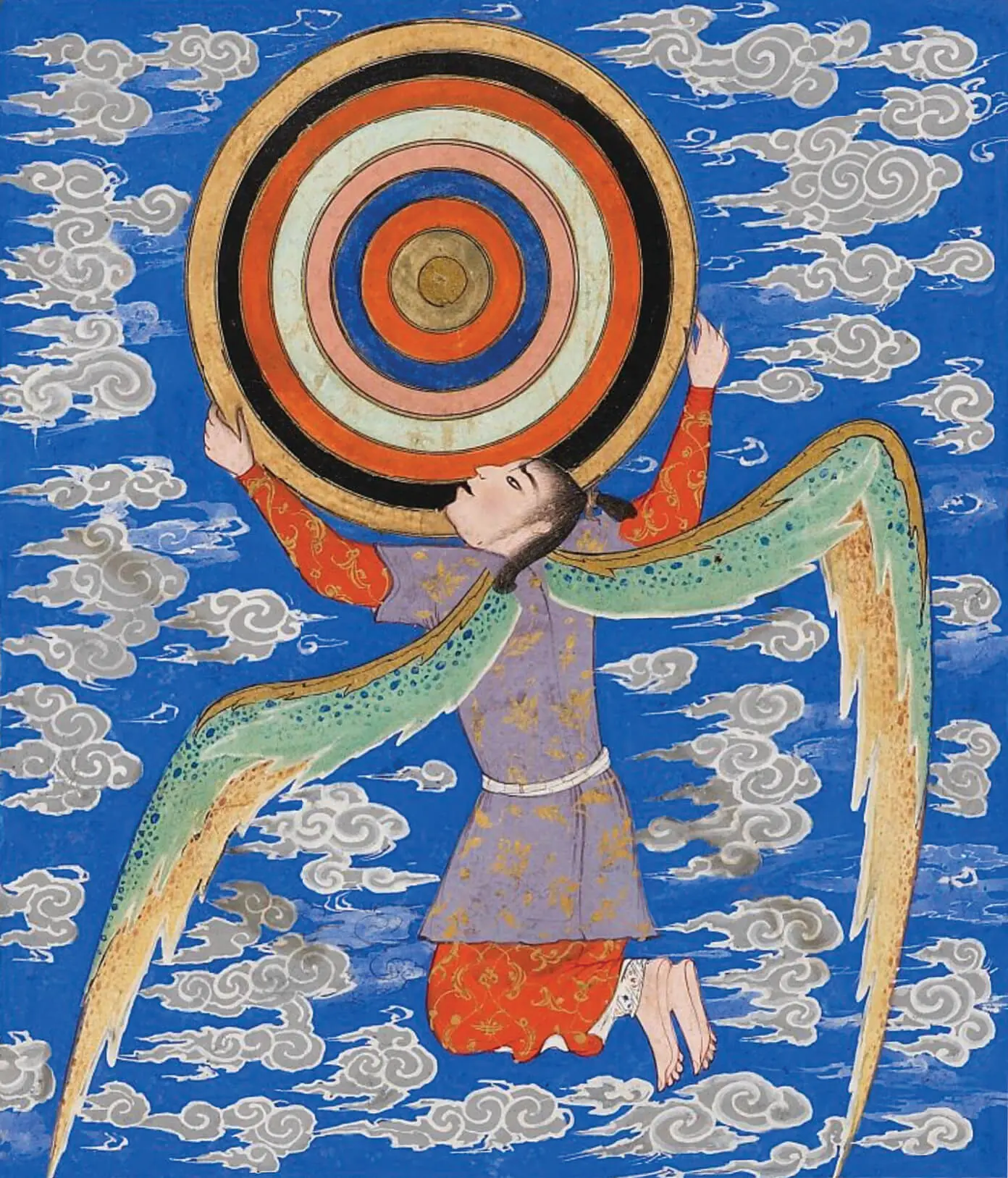
Along the medieval Silk Road, the universe was conceived as a projected image generated from a celestial book of codes.
In this alternative genealogy, the history of computation begins with creation itself. Before the world, there was a
cloud, the raw material of being. God was imagined as a calligrapher dwelling within a misty scriptorium. With pen and
tablet, the cosmic script was inscribed. These codes shaped the cloud through vibrations. Every being emerged as a
generated image, each form the visible trace of an underlying code.
From Baghdad to Black Holes
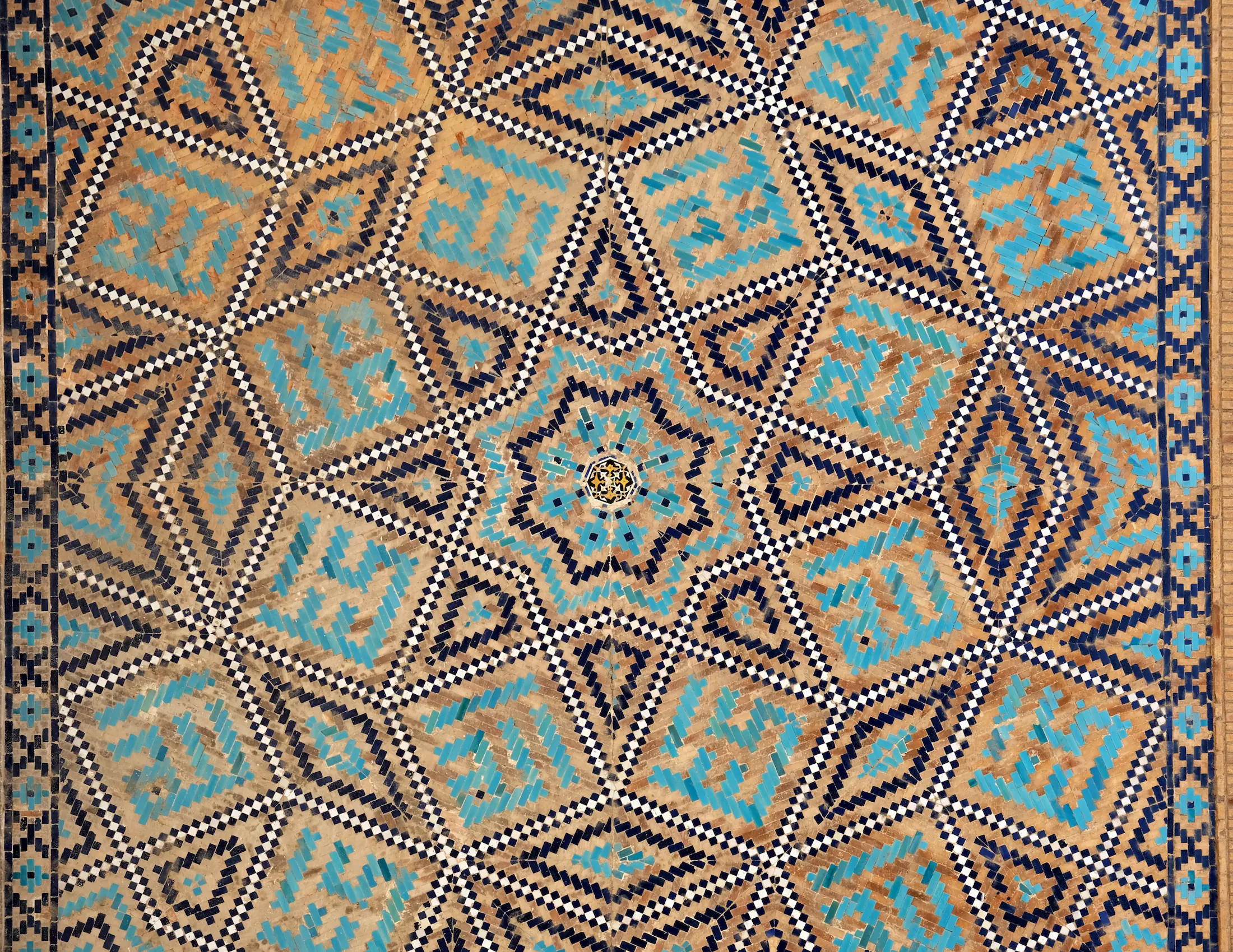
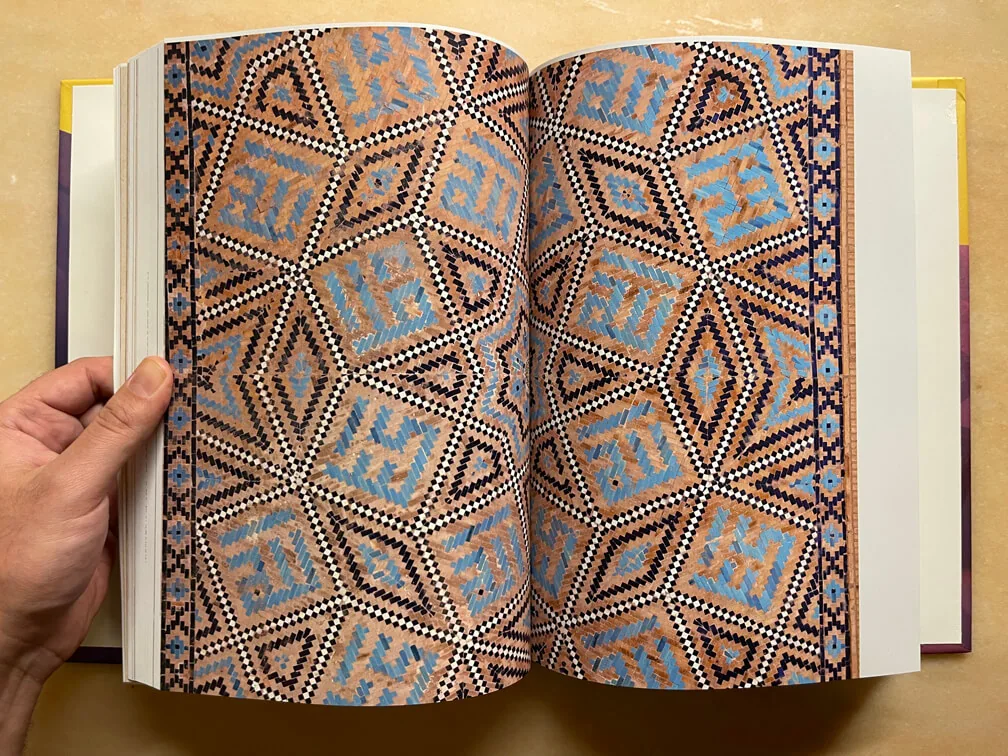
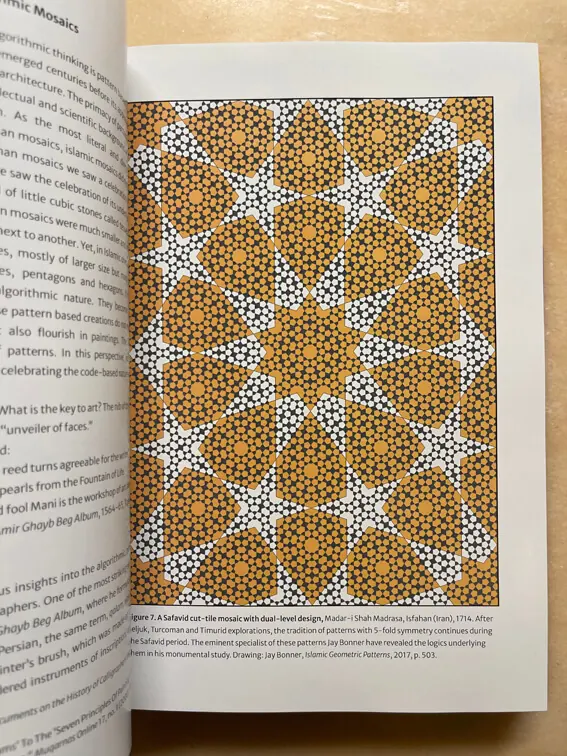
The code lived in mathematics. It was in medieval Baghdad that algorithms were invented. These mathematicians laid the foundations for the geometries that later allowed Einstein to revolutionize our understanding of space. This algorithmic tradition did not remain within manuscripts but became the decor of daily life. Turco-Persian mosaics depicted complex patterns modern scientists believed impossible to exist until their discovery just twenty years ago in extraterrestrial minerals on a meteorite.
Today, string theorists and quantum physicists revive a forgotten metaphor of the Silk Road: the pen and paper. Learning from black holes, the cosmos begins to appear fundamentally flat, like a sheet of paper. Between the manuscript and the quantum computer, we find a cosmopolitan history of a universe built of information rather than matter.
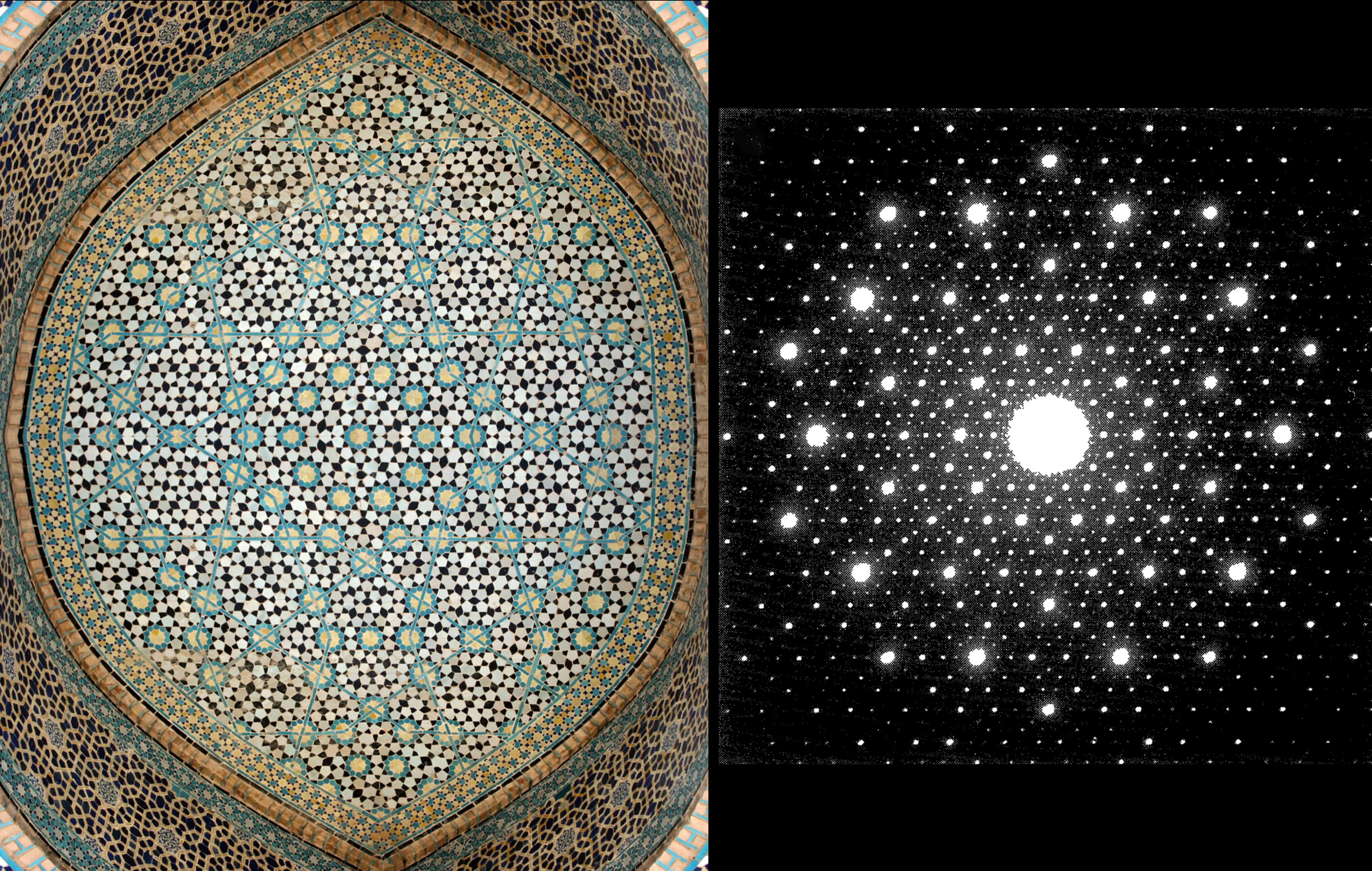
Quasicrystal mosaics on the tympanum of an iwan at the Darb-e Imam shrine, Isfahan (Iran), Turcoman Qara Qoyunlu period, 1453. The photo is mirrored to reveal the quasicrystal pattern. Algorithmic tile mosaics follow rotational rules that produce the so-called forbidden fivefold symmetry. Centuries before its formal recognition in modern mathematics and physics, Turco-Persian artisans conceived patterns that exceed the scientific frameworks of their time. The green lines traced across the yellow ten-pointed stars indicate a fragment of a larger, recursively constructed pattern.
Quasicrystal diffraction pattern. Electron diffraction pattern along the tenfold symmetry axis in an Al-Ni-Co quasicrystal, a synthetically grown alloy. This configuration exhibits the same forbidden symmetry observed in medieval tilework, where rotational order exists without periodic repetition. From "Structure and Structural Change of Al–Ni–Co Decagonal Quasicrystal by High-Resolution Electron Microscopy" (Hiraga et al., 1991).The Original Hackers
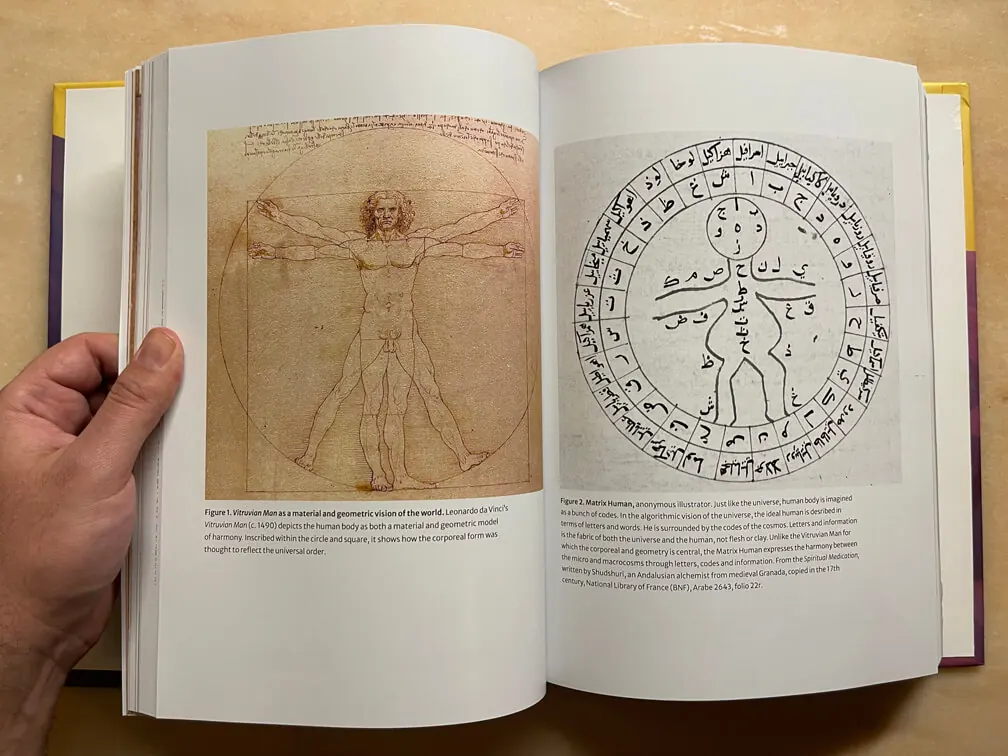
Before software, there was the talisman. In Herat, Afghanistan, the “Silicon Valley” of the 15th century, scientists produced advanced analog computers known as astrolabes. Scholars practiced ilm-i huruf, the science of letters. Organized in secretive networks, these lettrists sought to manipulate the algorithmic fabric of existence. They were the ancestors of the contemporary hacker, connecting to an intangible repository of knowledge they, too, called “The Cloud.”
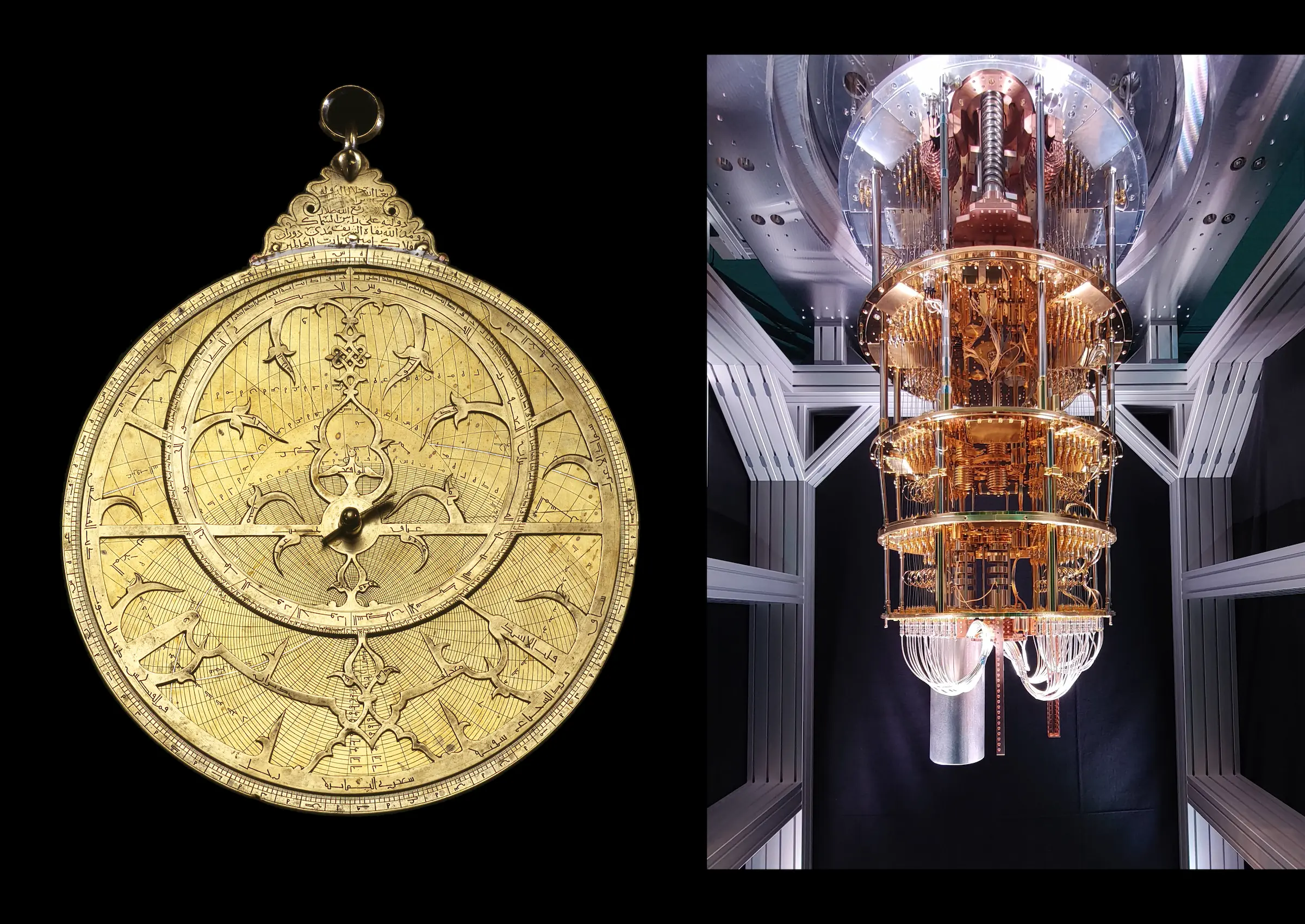
Left:Timurid astrolabe, made by Muhammad ibn Jafar ibn Umar al-Asturlabi in 1427, and probably commisioned by Shah Rukh the Timurid emperor in Herat (Afghanistan). An astrolabe is a kind of ancient computer that simulates the rotation of the heavenly bodies in a plane projection on the instrument. The David Collection, Inv. no. D 25/1986, Copenhagen, Denmark.
Right:IQM quantum computer, Espoo, Finland, 2022.
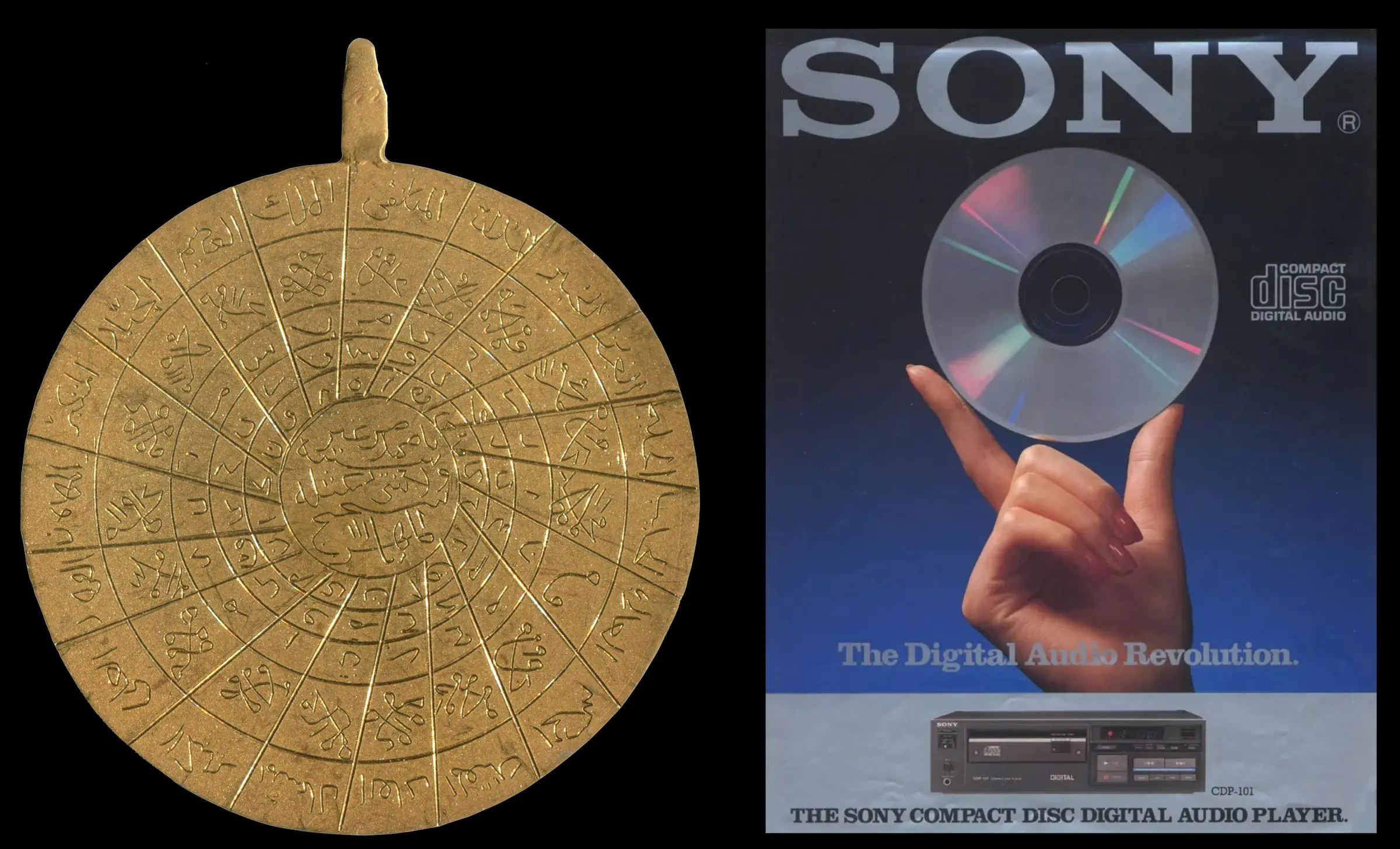
Two different code matrices engraved on circular, conductive metal disks.
Left: Talismanic matrix engraved on a gold plate,
crafted
by my
grandfather Kadir Dişlitaş in Isparta, Turkey, around 1999 and preserved in our family
inheritance.
The
diagram consists of five concentric rings and nineteen radial divisions, forming
ninety-five
cells
around a central motif. Arabic letters populate most cells. The inner rings arrange letters according to
principles of
mathematical harmony, while the outer ring bears the names of God. Between them appears an enigmatic
sequence
known as
the celestial alphabet, where constellations become letters. Combining mathematics, divine names, and
stellar
forces,
the talisman functioned as a form of pre-digital programming, writing codes believed to channel invisible
powers
and
protect its bearer. Photograph by the author.
Right: Advertisement poster for the Sony Compact Disc Player, 1982, introducing the compact disc as a new medium of digital information. Data is encoded as microscopic pits carved by a laser into a plastic disc coated with a reflective metal layer such as aluminum, silver, or gold. An optical reader scans these patterns of reflection to reconstruct the signal. The CD transforms the circular surface of the disc into a matrix of digital code.
We have been writing programs on metal reflective disks, once by hand, then by lasers. Long before we came up with digital computers, we used language, light and metals in attempts at creating and controlling virtual, intangible worlds. Once they yielded in imaginary, metaphysical worlds, now they form immersive technological environments.
The Encoded City
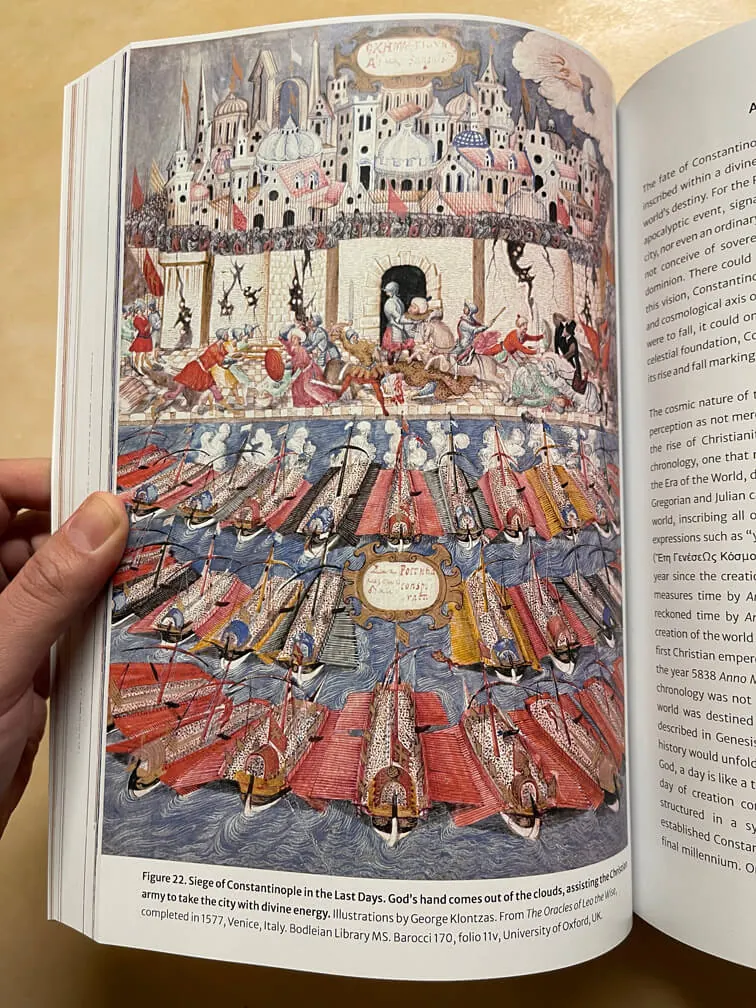
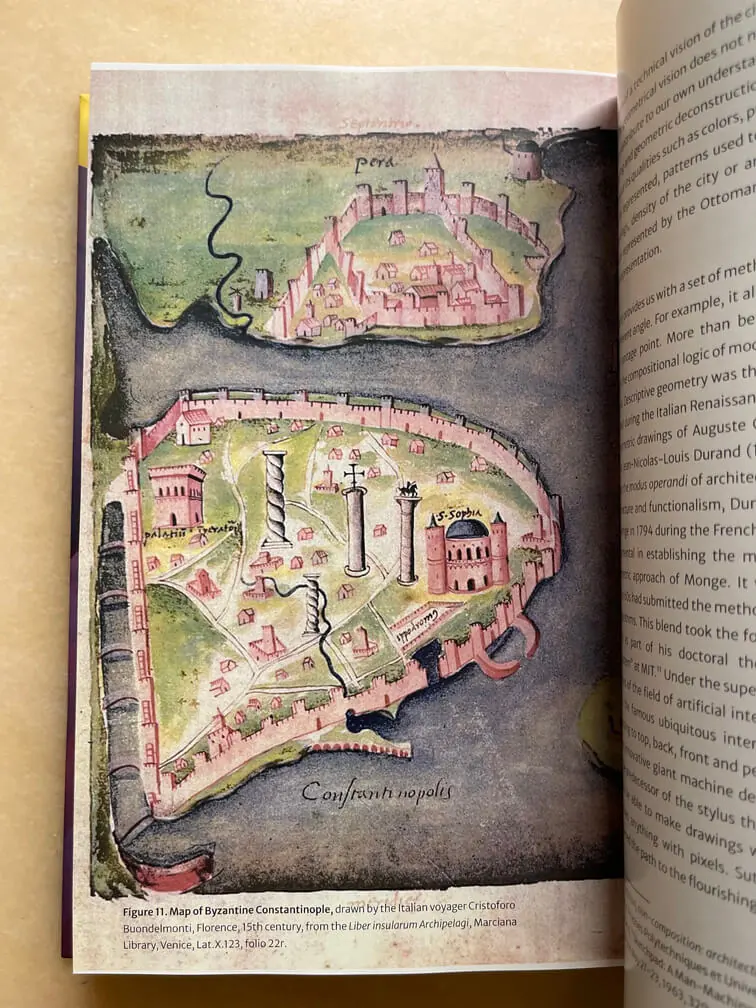
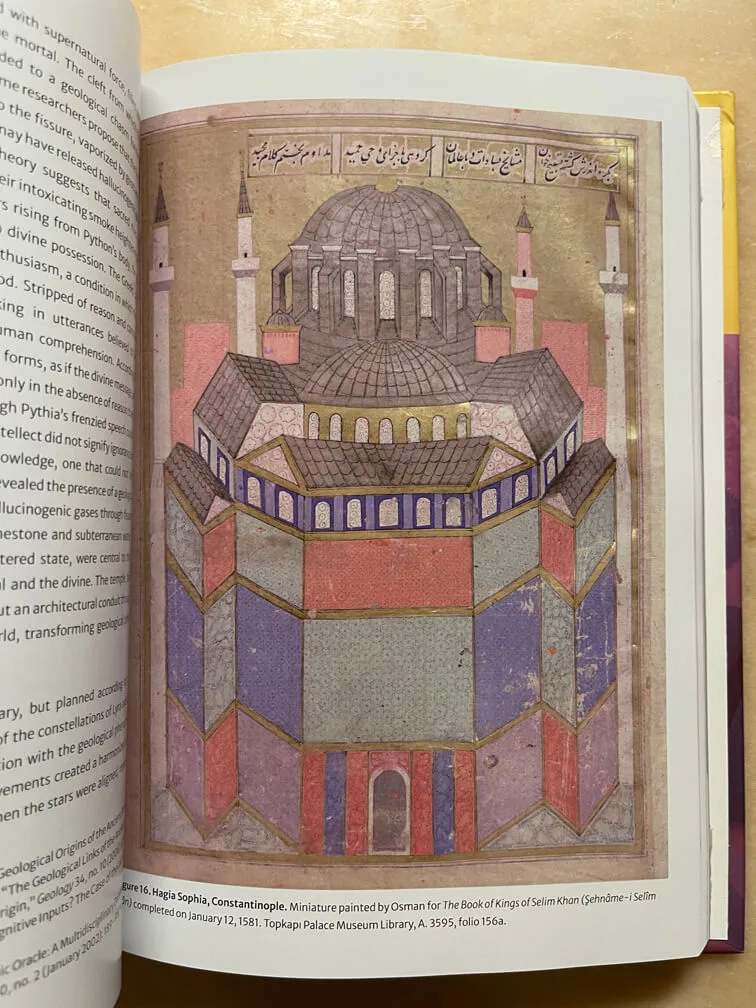
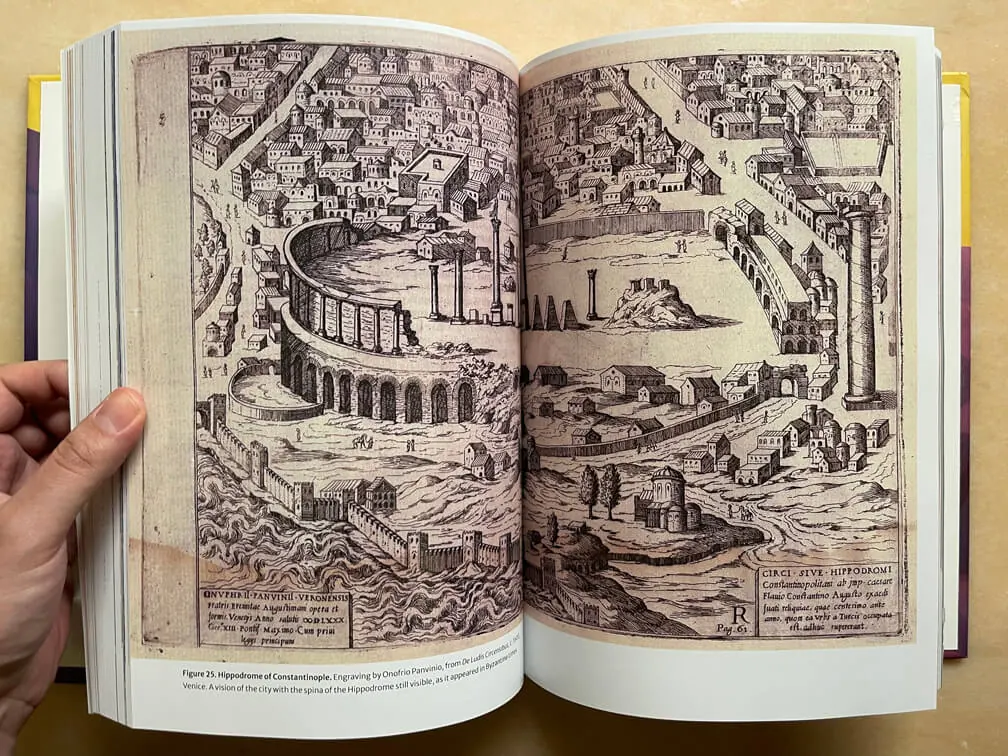
Information was the fabric of urban space. Along the Silk Road, buildings were books of stone; cities were written and read. In a secret manuscript of the Ottoman sultans, Constantinople appears as a living cipher, an urban space woven from cryptic algorithms of prophecy. The variegated worlds of miniatures reflected this urban encryption.
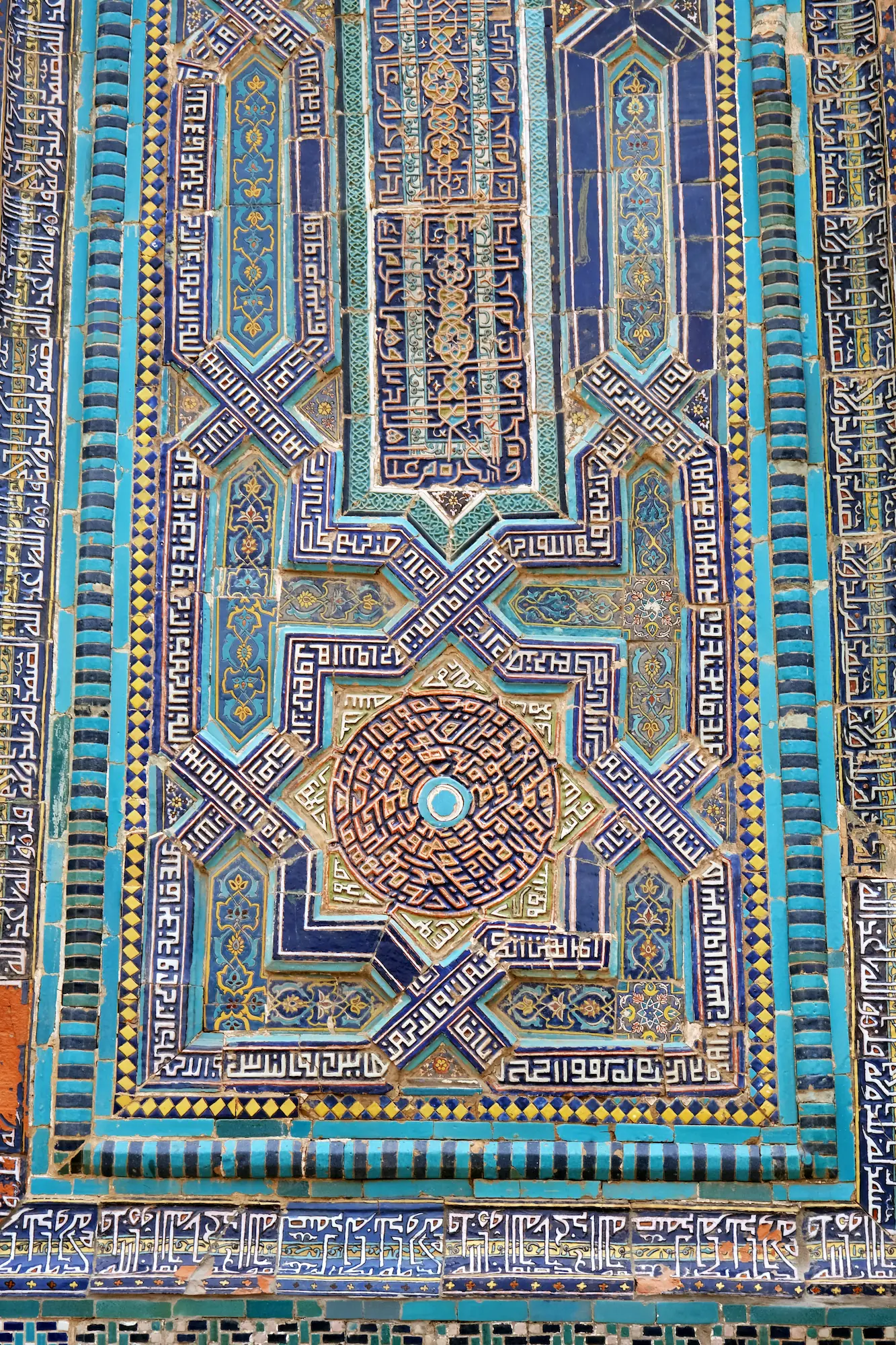
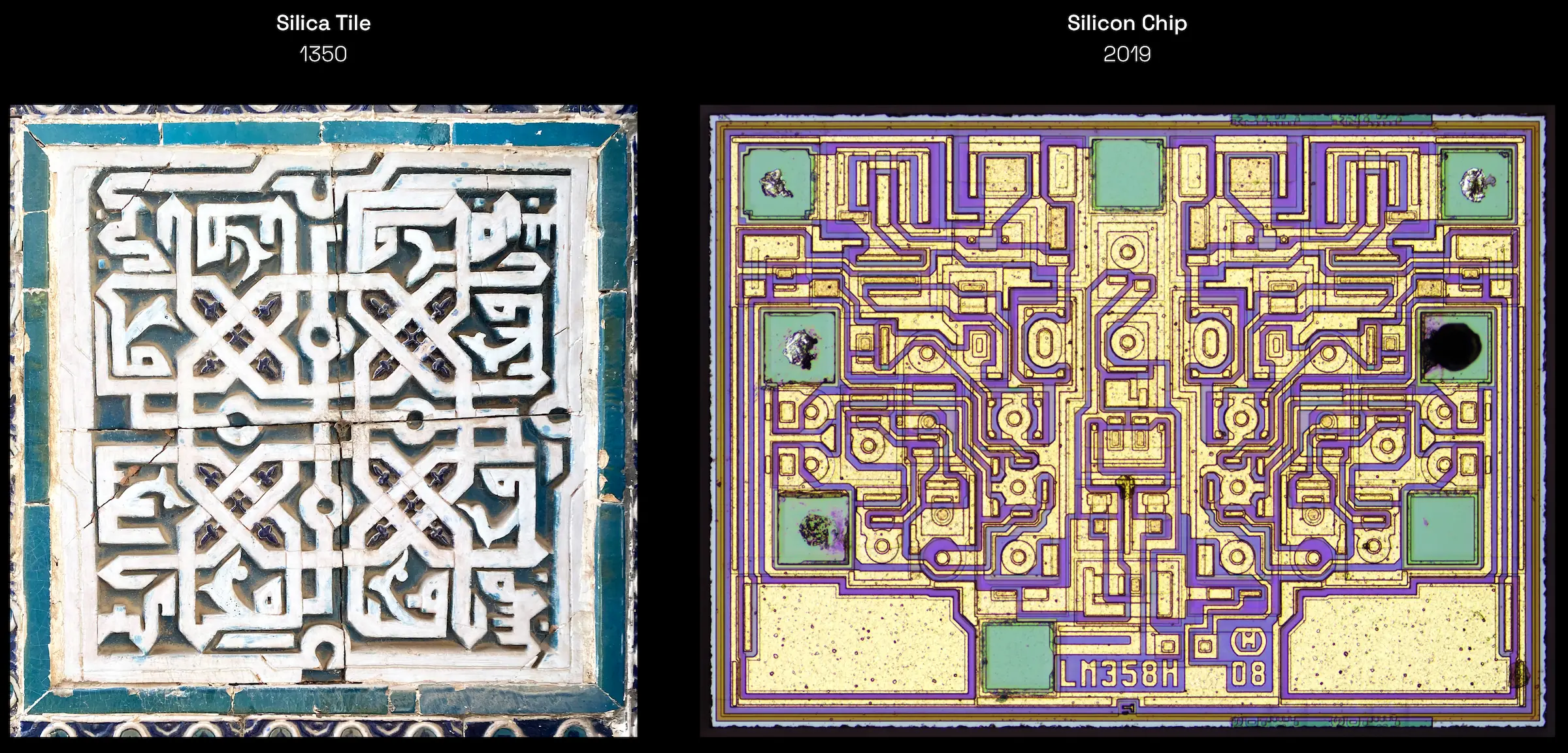
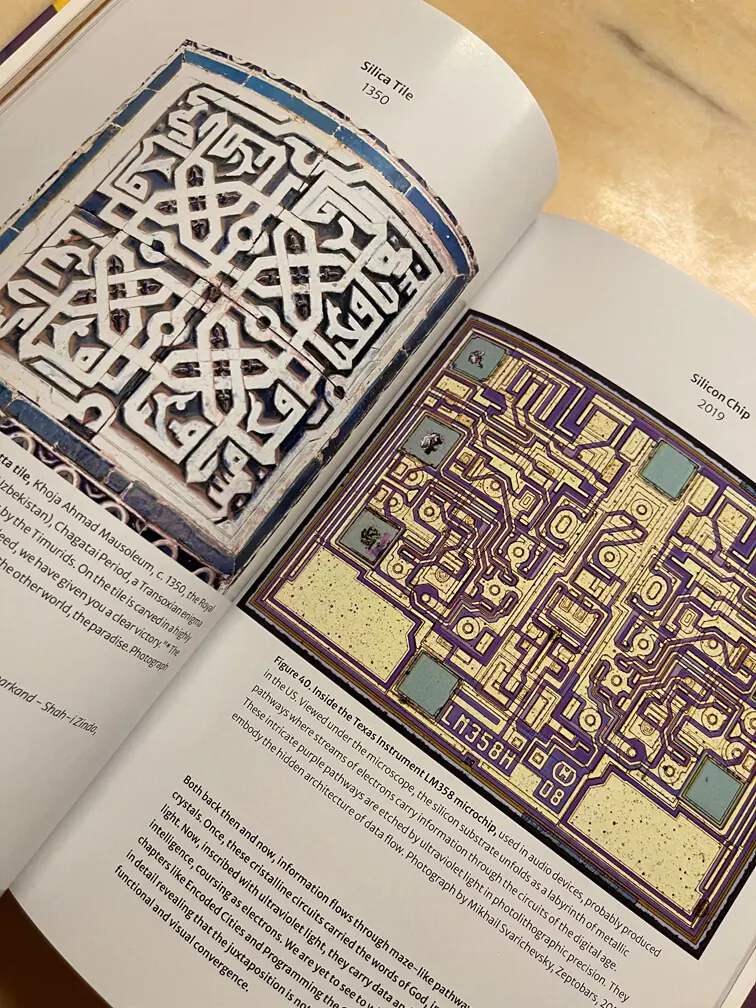
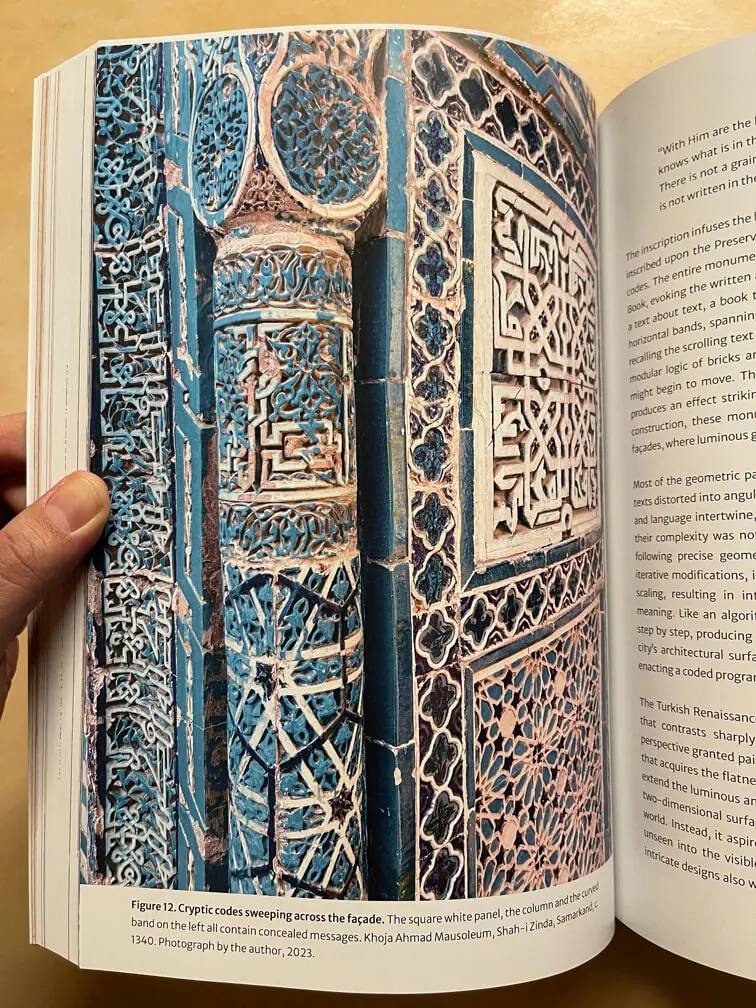
Left: Carved and glazed terracotta tile, Khoja Ahmad Mausoleum, c. 1350, Royal Necropolis of Shah-i Zinda, Samarkand (Uzbekistan), Chagatai period. A Transoxian enigma predating the introduction of Iranian models under the Timurids. The surface bears a highly stylized Kufic inscription of a sacred verse: “Indeed, we have given you a clear victory.” The victory of Master Ahmad is understood as triumph over the other world, entry into paradise. Photograph by Mete Kutlu, 2022.
Right: Interior of an LM358 microchip by Texas Instruments. Viewed under a microscope, the silicon substrate unfolds as a labyrinth of metallic pathways through which electrons carry information. These intricate purple circuits are etched by ultraviolet light through photolithographic processes. They reveal the hidden architecture of data flow. Photograph by Mikhail Svarichevsky, Zeptobars, 2019.
Both back then and now, information flows through maze-like pathways, inscribed in quartz crystals. Once, these cristalline circuits carried the words of God, imagined to be made of divine light. Now, inscribed with ultraviolet light, they carry data and the commands of artificial intelligence, coursing as electrons. The juxtaposition is not a mere analogy, but a deep material, functional and visual convergence.
From Sophia to Data
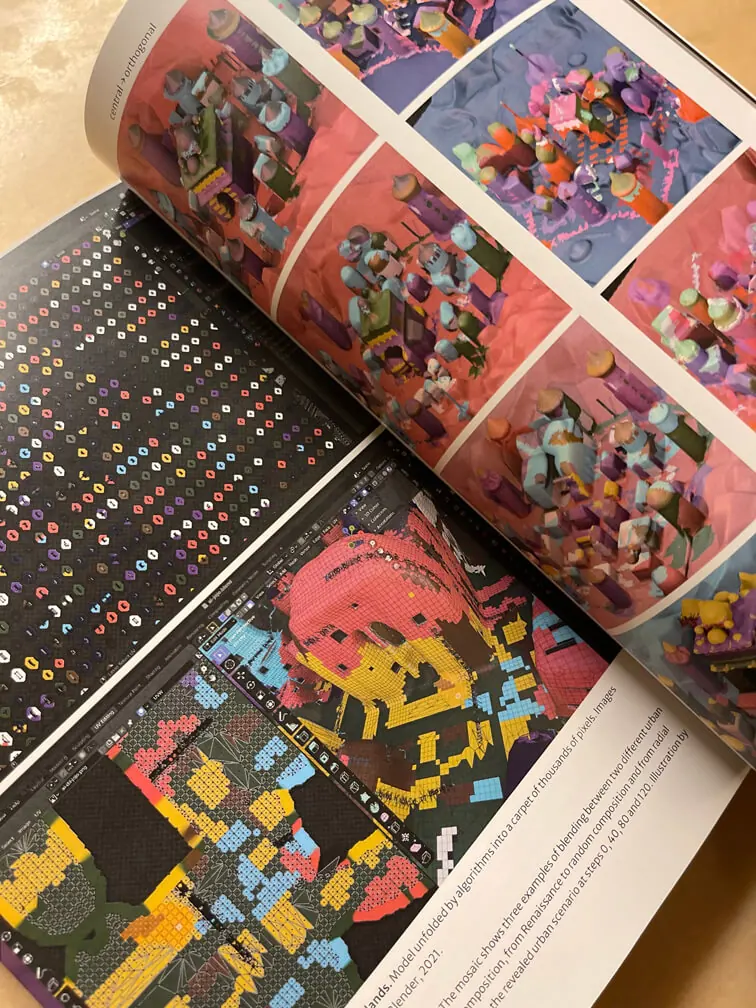
The book concludes with three digital experiments. Through 3D modelling of a miniature, we take a stroll inside an imaginary Constantinople. By blending French rationalism with Ottoman mysticism, the research reveals the shared origins of The Matrix (1999) and Ottoman myths in the Jewish Kabbala. Through pixel interpolation and procedural design, we explore the decisive shift in human creativity. We witness the final transformation of the sacred: the algorithmic evolution of Hagia Sophia into Hagia Data.