Scroll to open the book
Book V
Synthetic Minds
Data Becomes Space,
Thought Becomes Cloud
Empire of Clouds · Codes, Colors and Cosmos

Nebulous Minds

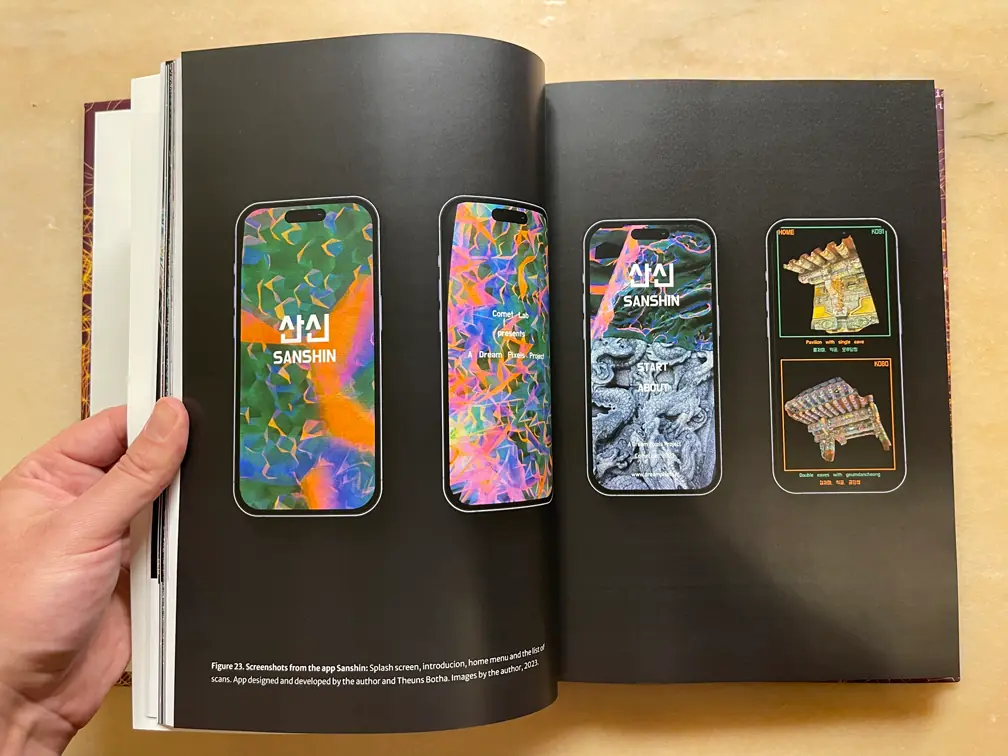
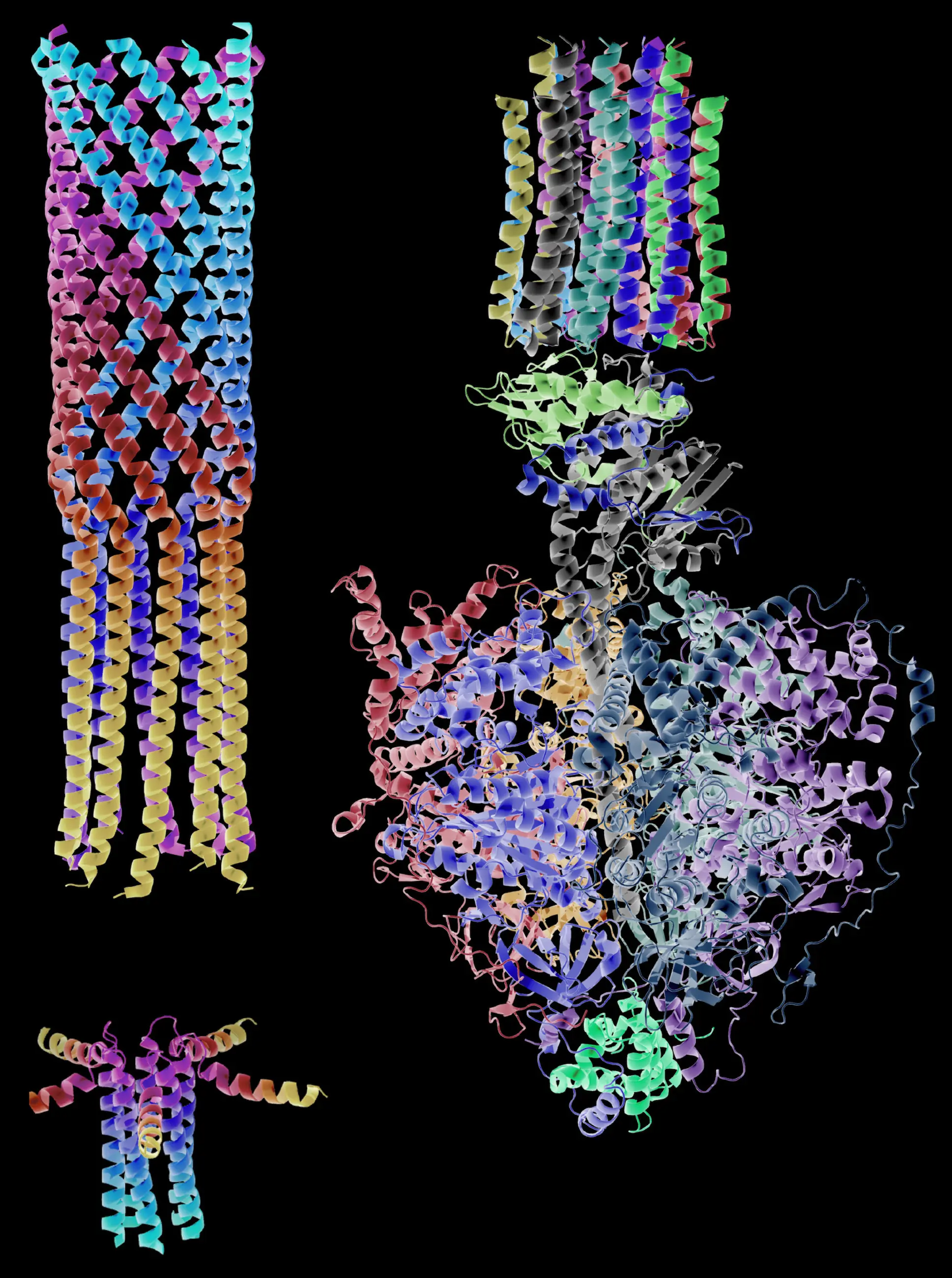
Based on a 3D scanning mission of Buddhist temples in South Korea, two experiments explore the translation of metaphysical light into electronic energy. By training AI on dancheong, the vibrant mandalas of temple architecture, sacred ornament is reimagined as a virtual cosmogram. AI sculpts these images by overlaying cloud patterns. Research and originality are redefined today less as calculation than as navigation within the mind of AI, visualized as point clouds. The cloud becomes the shape of thought. Through the example of AlphaFold, where clouds, crystals, and helices intersect, the book shows how AI encourages a nonlinear understanding of knowledge and creativity.
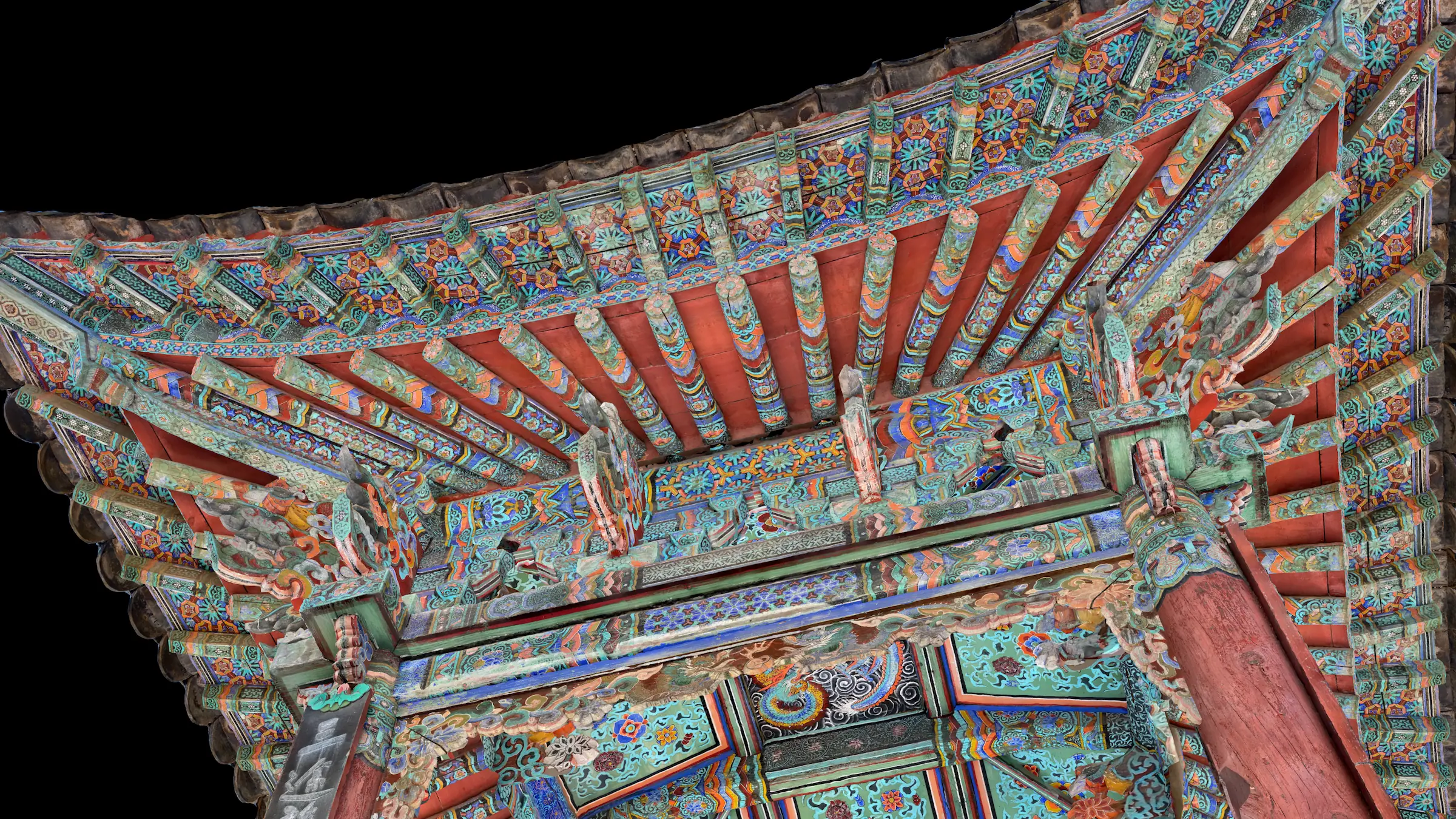
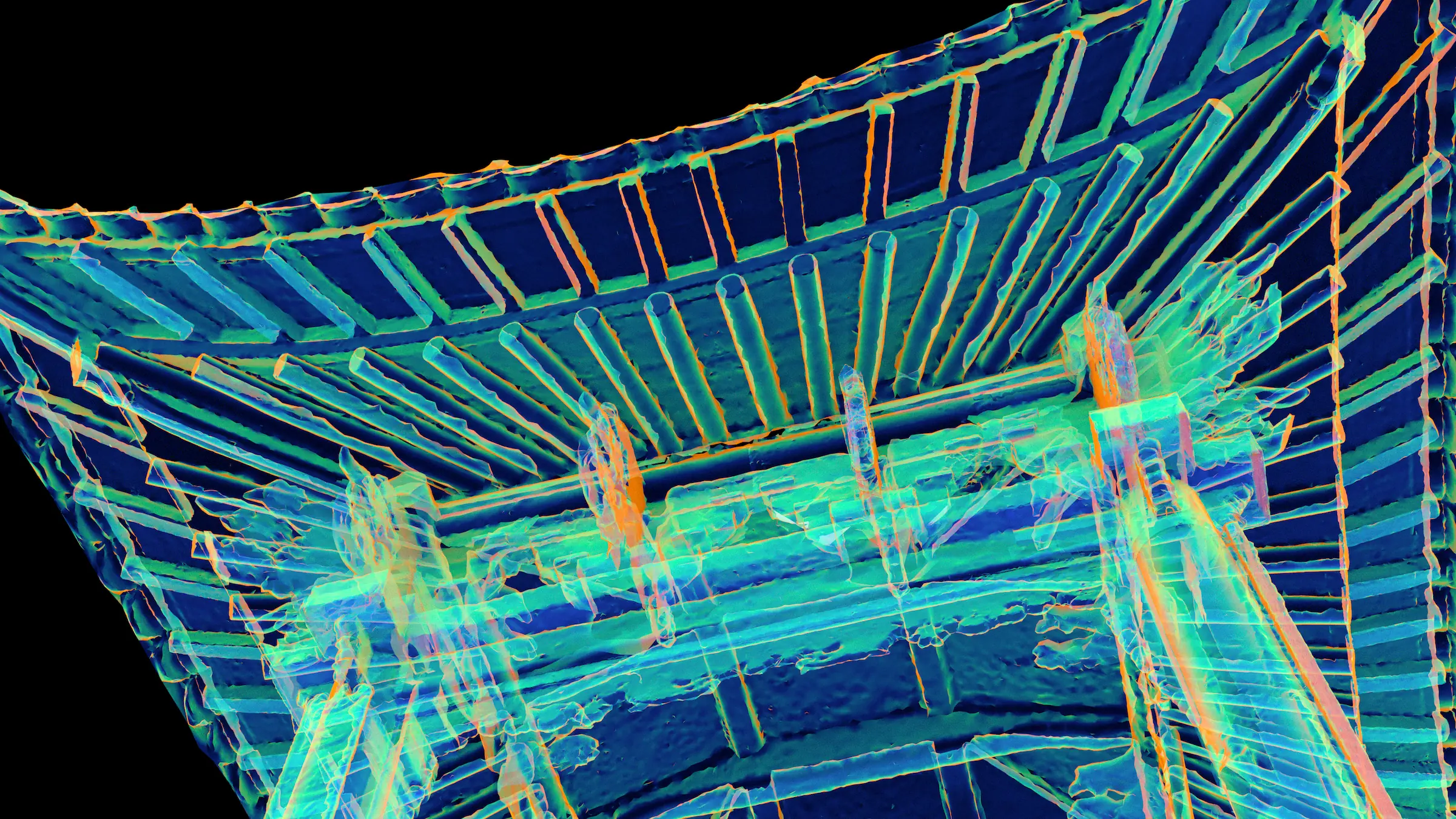
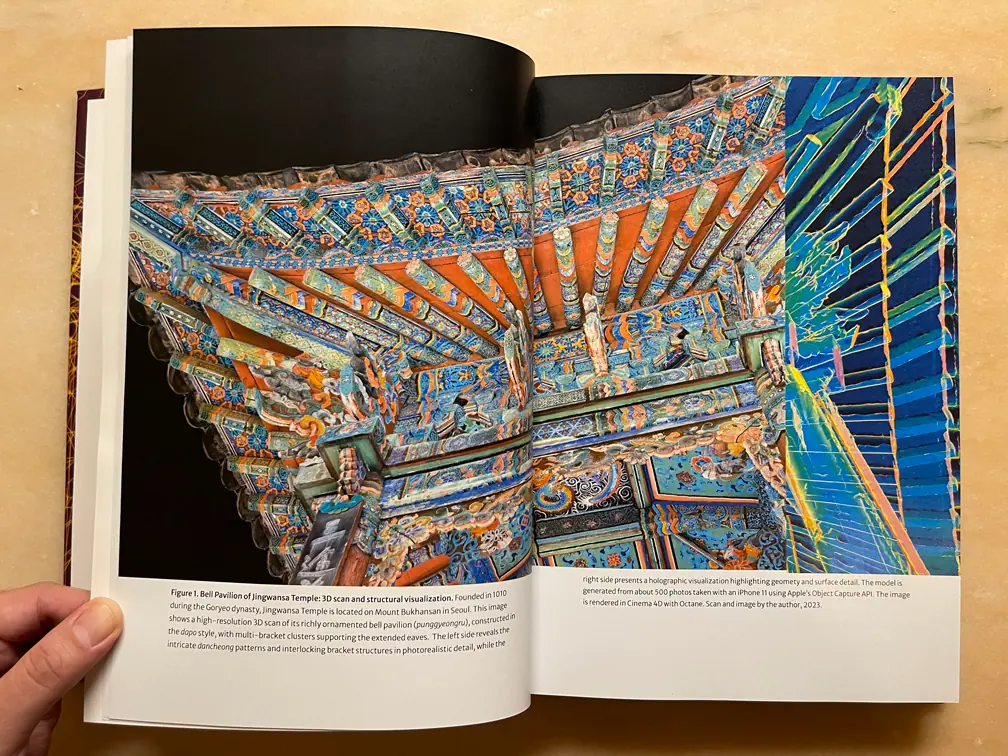
Photorealistic texture of the 3D scan — bell pavilion (punggyeongru) of Jingwansa Temple, Mount Bukhansan, Seoul, South Korea. Dancheong painted bracket clusters in the dapo style, Goryeo dynasty, founded 1010. Scan by Mete Kutlu, 2023
Depth Texture
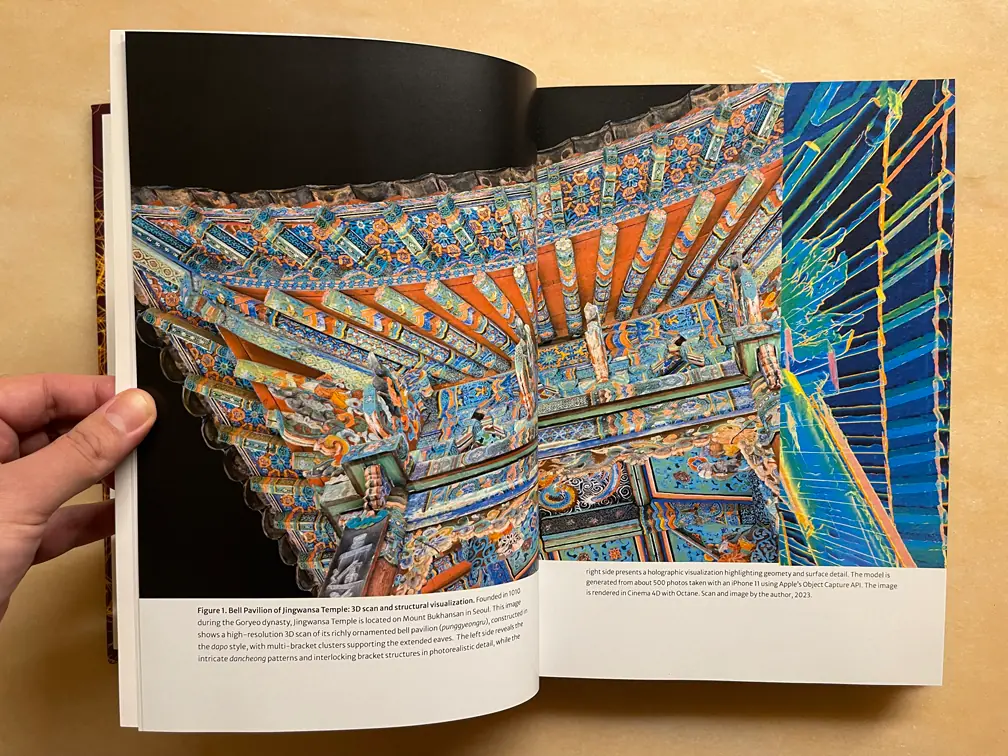
Bell Pavilion of Jingwansa Temple: 3D scan and structural visualization. Founded in 1010 during the Goryeo dynasty, Jingwansa Temple is located on Mount Bukhansan in Seoul. This image shows a high-resolution 3D scan of its richly ornamented bell pavilion (punggyeongru), constructed in the dapo style, with multi-bracket clusters supporting the extended eaves. The left side reveals the intricate dancheong patterns and interlocking bracket structures in photorealistic detail, while the right side presents a holographic visualization highlighting geometry and surface detail. The model is generated from about 500 photos taken with an iPhone 11 using Apple’s Object Capture API. The image is rendered in Cinema 4D with Octane. Scan and image by Mete Kutlu, 2023.
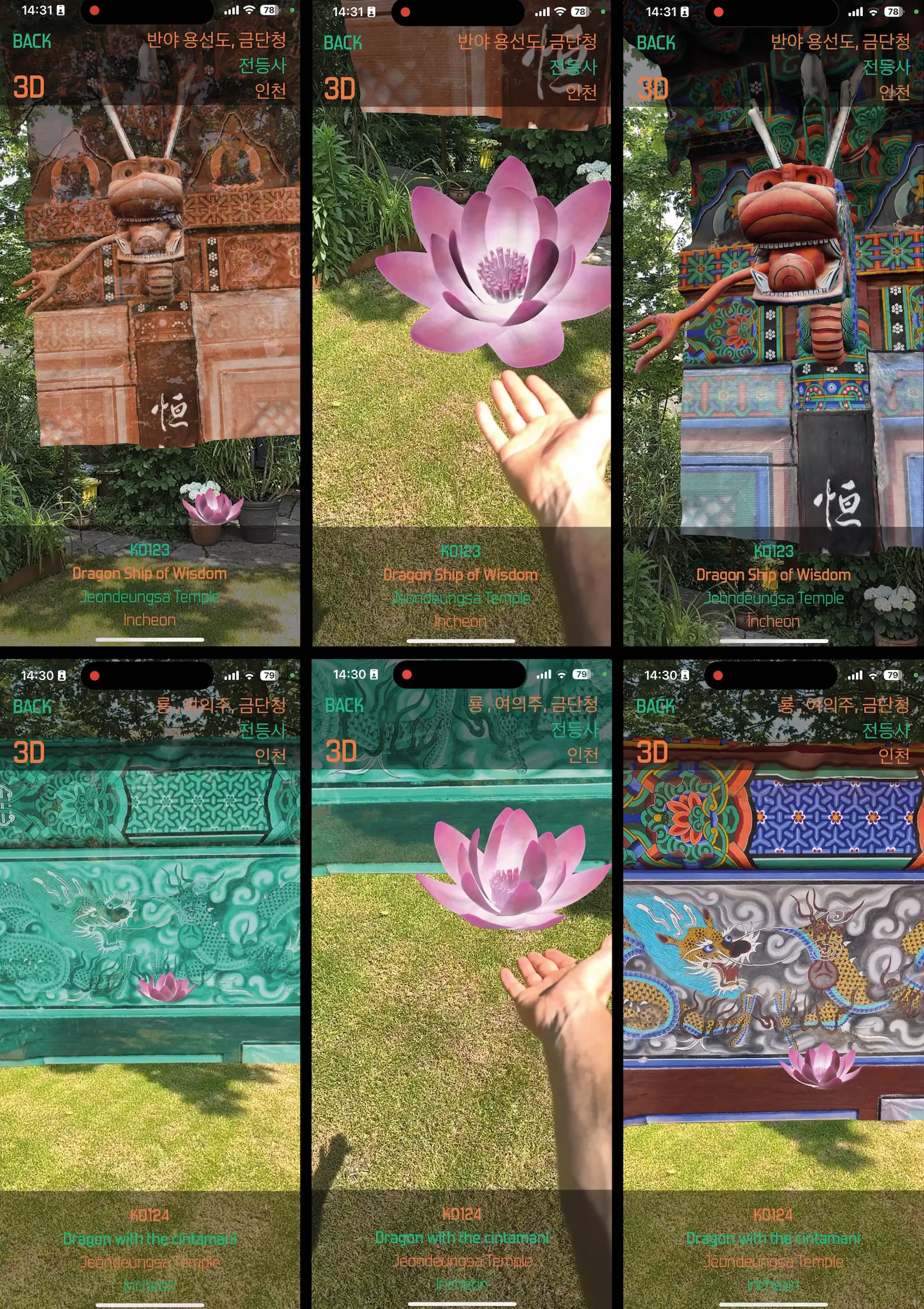
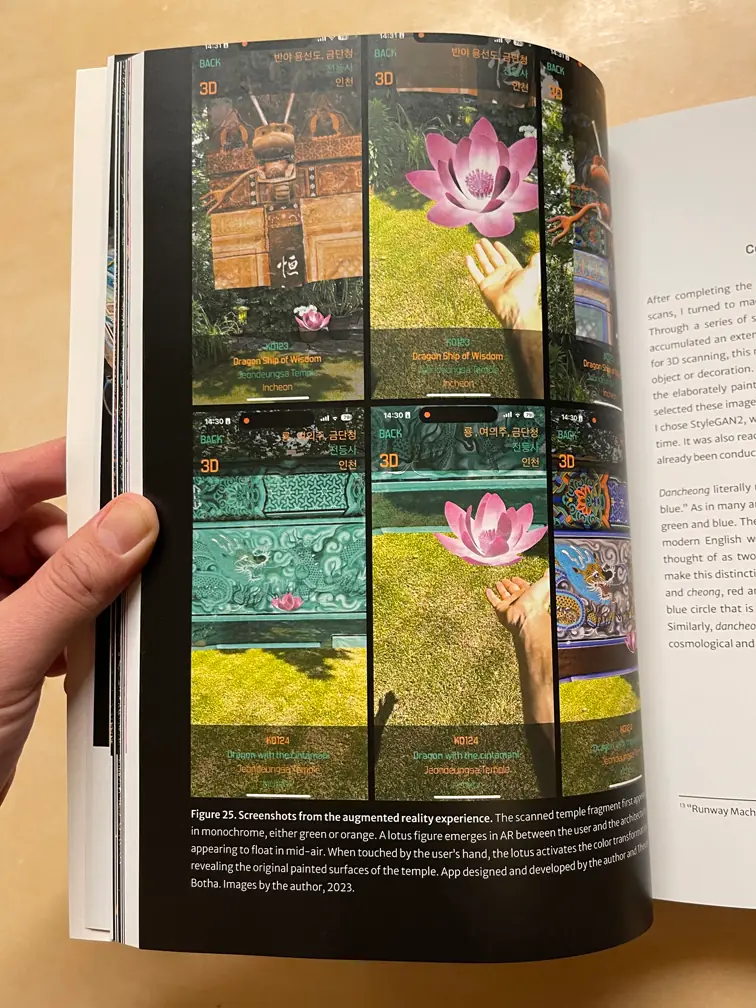
Augmented reality app screenshots showing a scanned Korean temple bracket fragment — first rendered in monochrome green and orange, then a lotus figure floating in mid-air activates a color transformation revealing the original painted surfaces. Designed by Mete Kutlu and Theuns Botha, 2023
Augmented reality experience with scanned temple fragment. Screenshots from the AR application. The scanned architectural fragment first appears in monochrome, rendered either in green or orange. A lotus figure emerges between the user and the structure, floating in mid-air as an interactive element. When touched by the user’s hand, the lotus activates a color transformation, revealing the original painted surfaces of the temple. App designed and developed by Mete Kutlu and Theuns Botha, 2023.
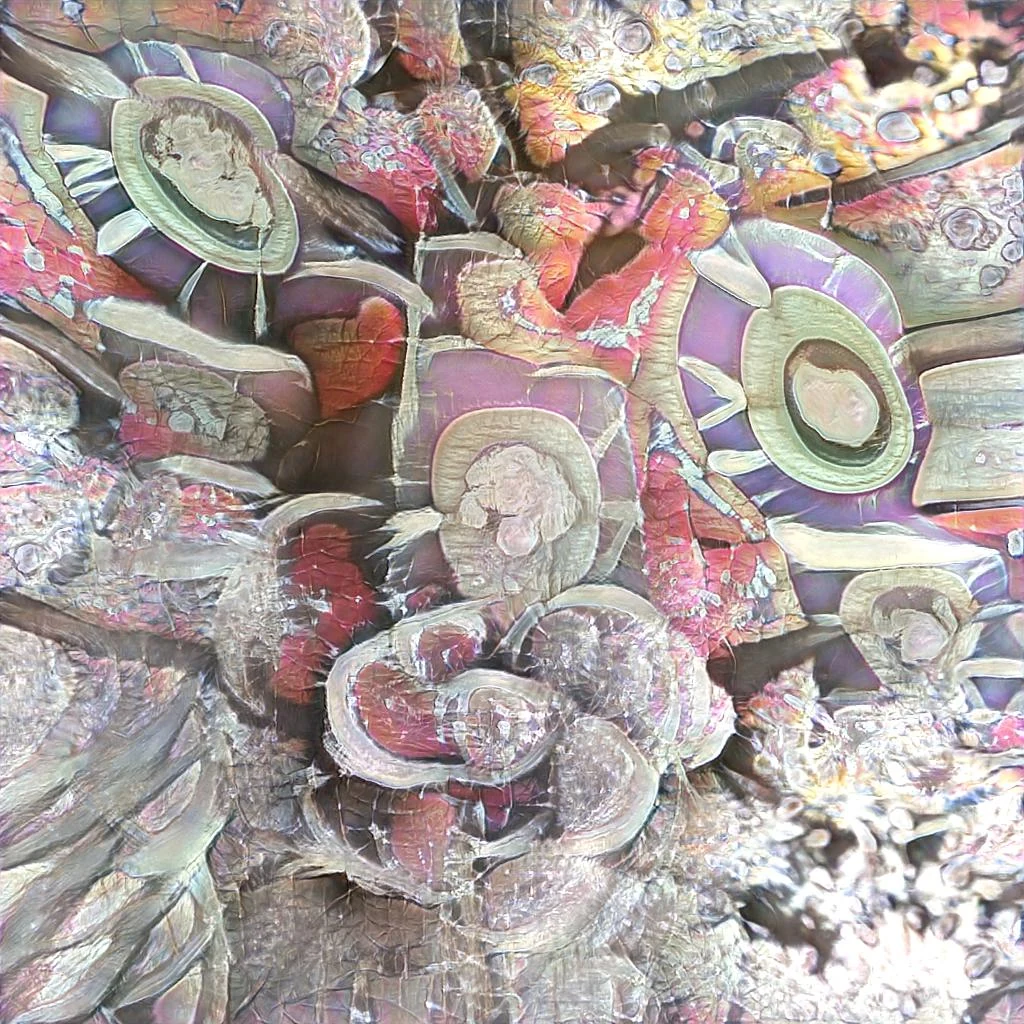
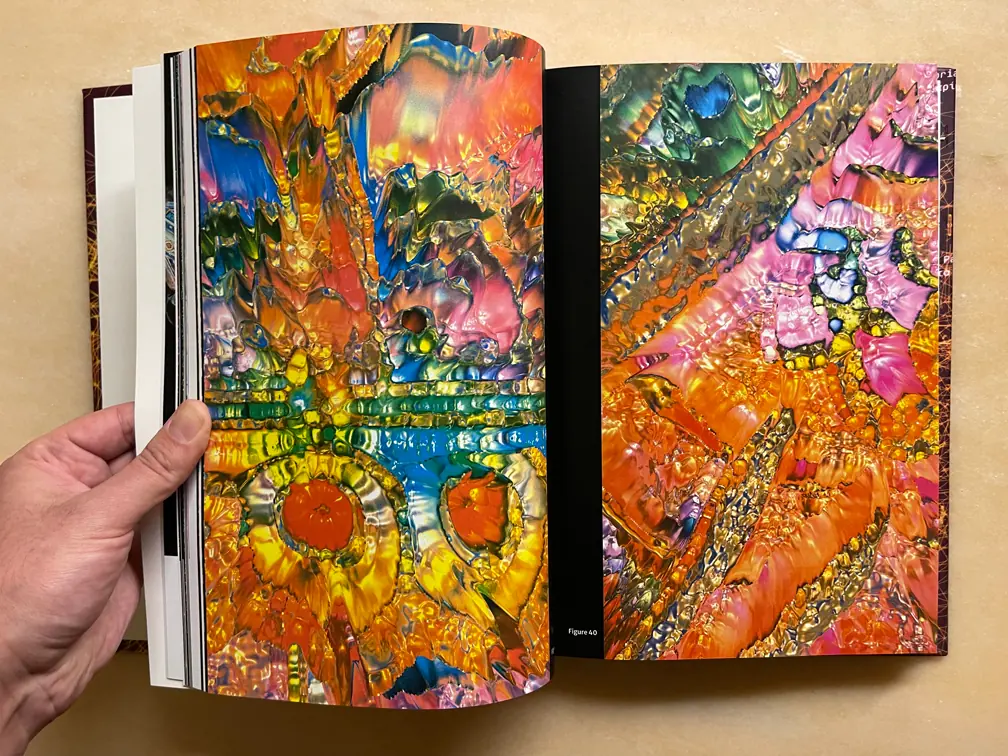
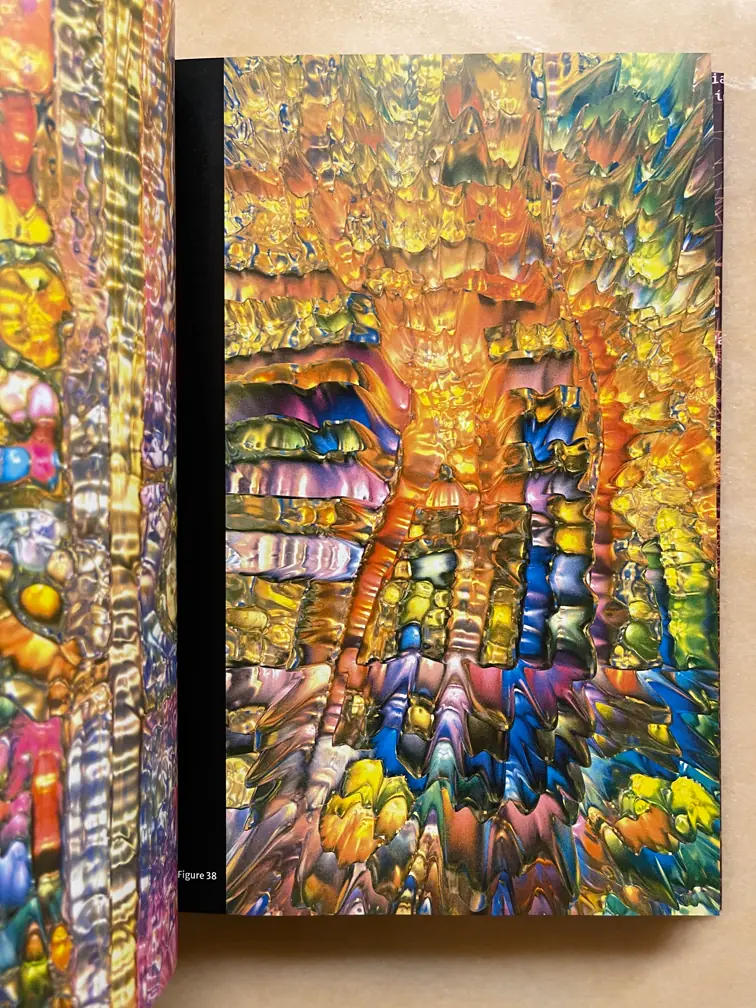
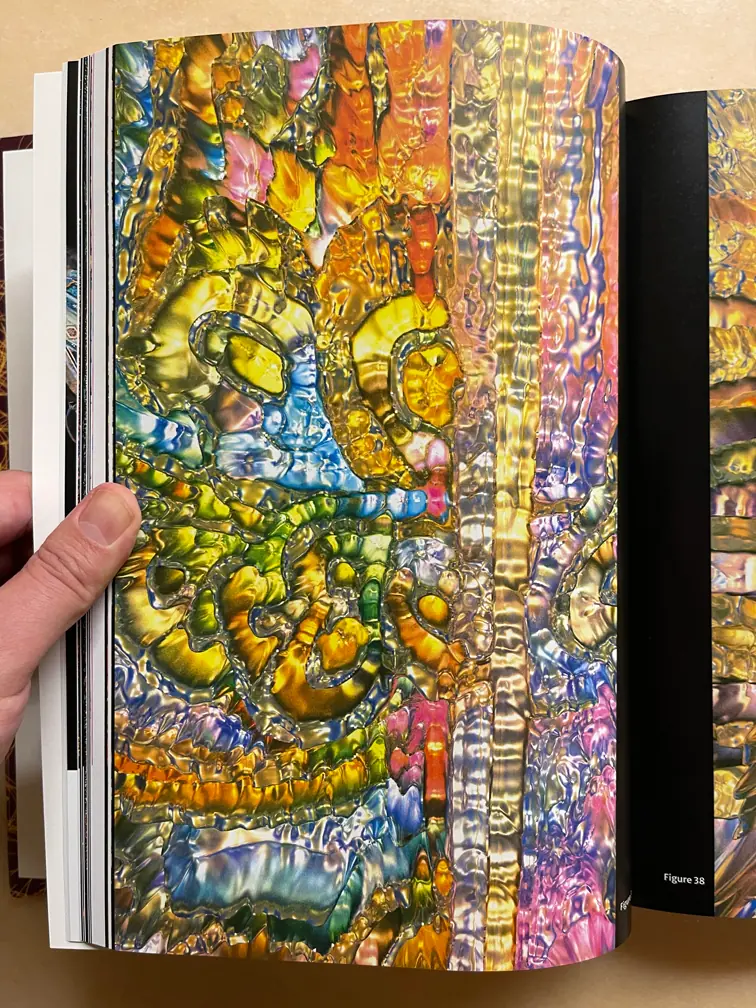
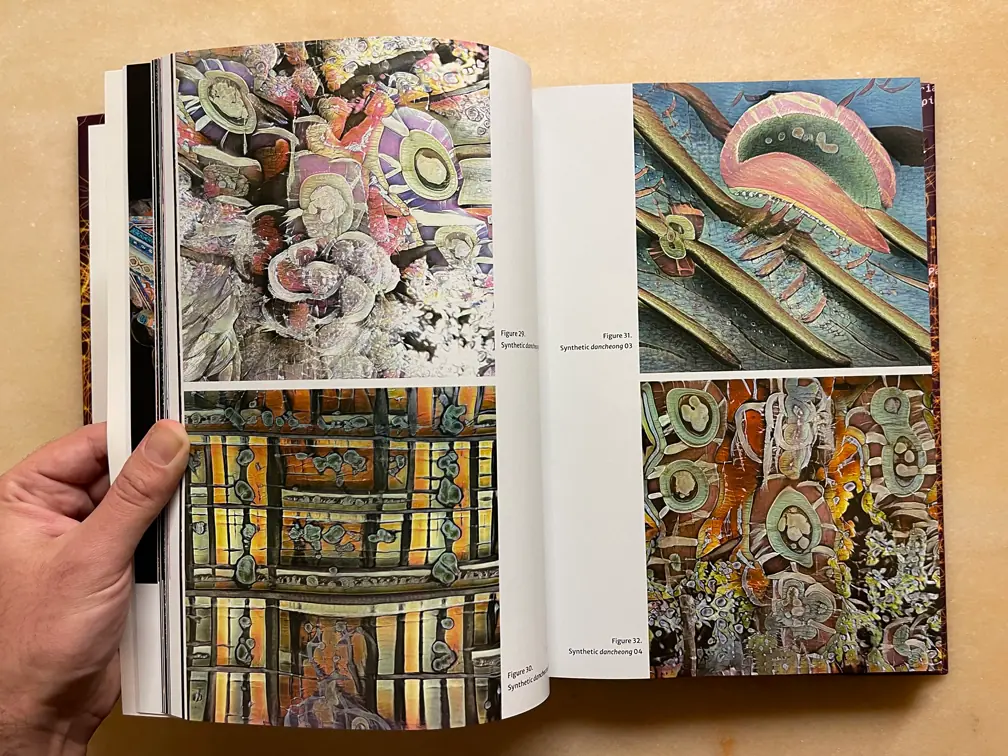
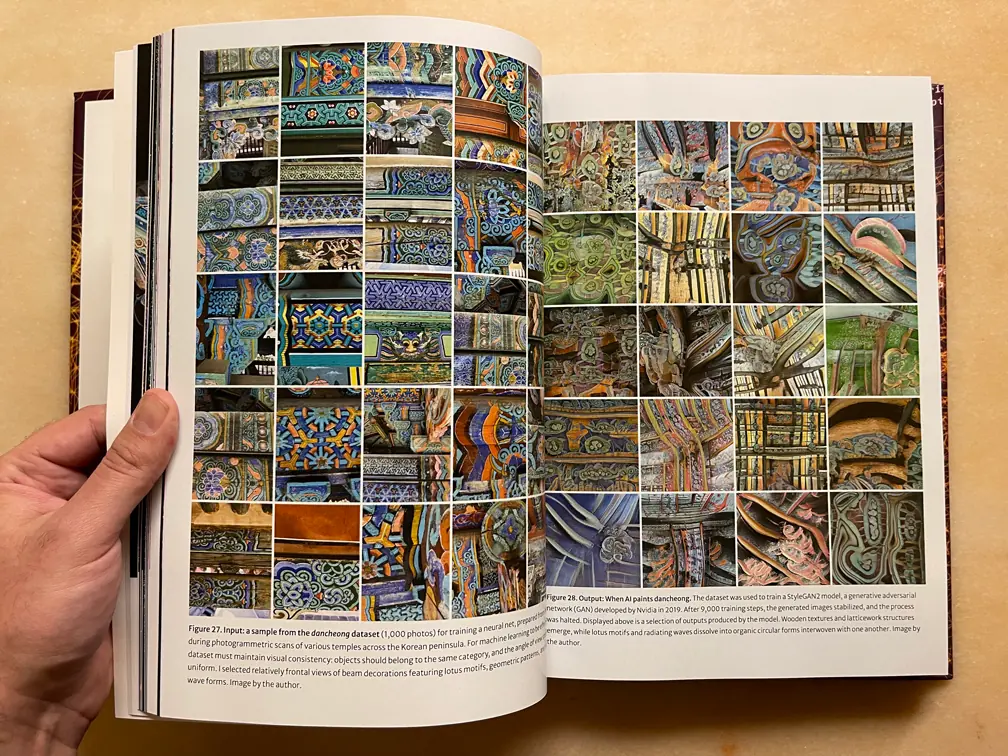
AI-generated dancheong image produced by a StyleGAN2 model trained on 1,000 photographs of Korean temple paintings — synthetic composition showing dissolved lotus motifs, lattice patterns, and wave forms as fluid concentric bubbles. Mete Kutlu, 2023

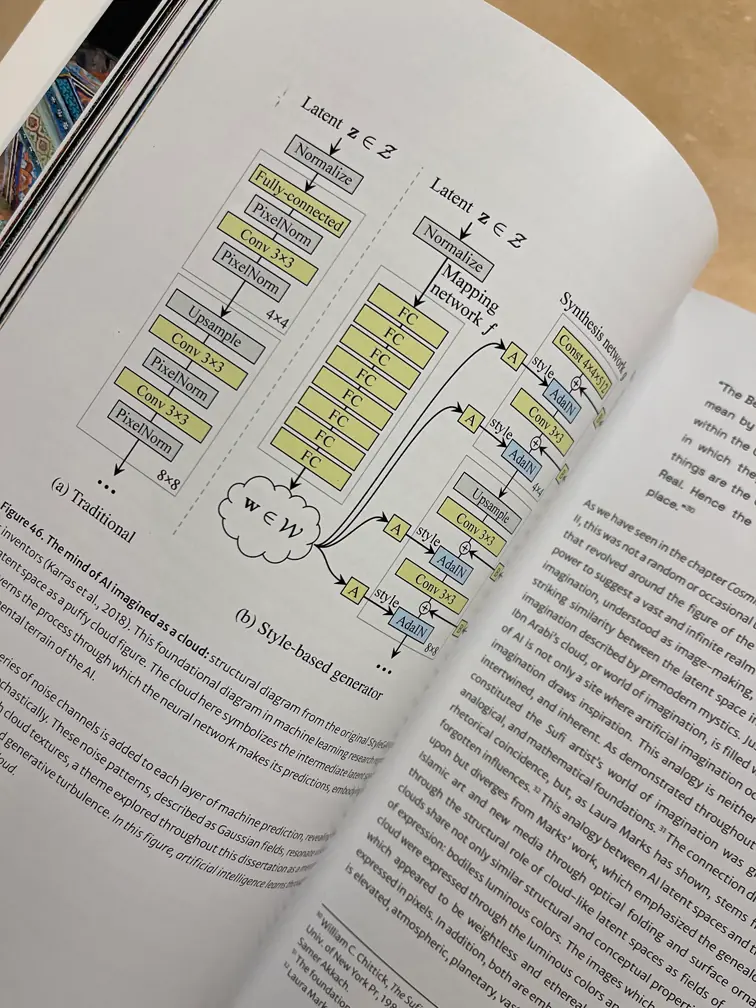
When AI paints dancheong, Mete Kutlu, 2023. The image emerges from a StyleGAN2 model trained on a dataset of 1,000 photographs of Korean temple paintings collected during photogrammetric scans across the Korean peninsula. To ensure effective training, the dataset was composed of relatively frontal views of beam decorations, maintaining consistent scale and orientation. Lotus motifs, geometric ornaments, and radiating wave patterns formed the visual vocabulary of the training set. After 9,000 training steps, the network began producing stable images. In these synthetic compositions, wooden structures and lattice patterns reappear, while lotus motifs and wave forms dissolve into fluid concentric and growing bubbles.
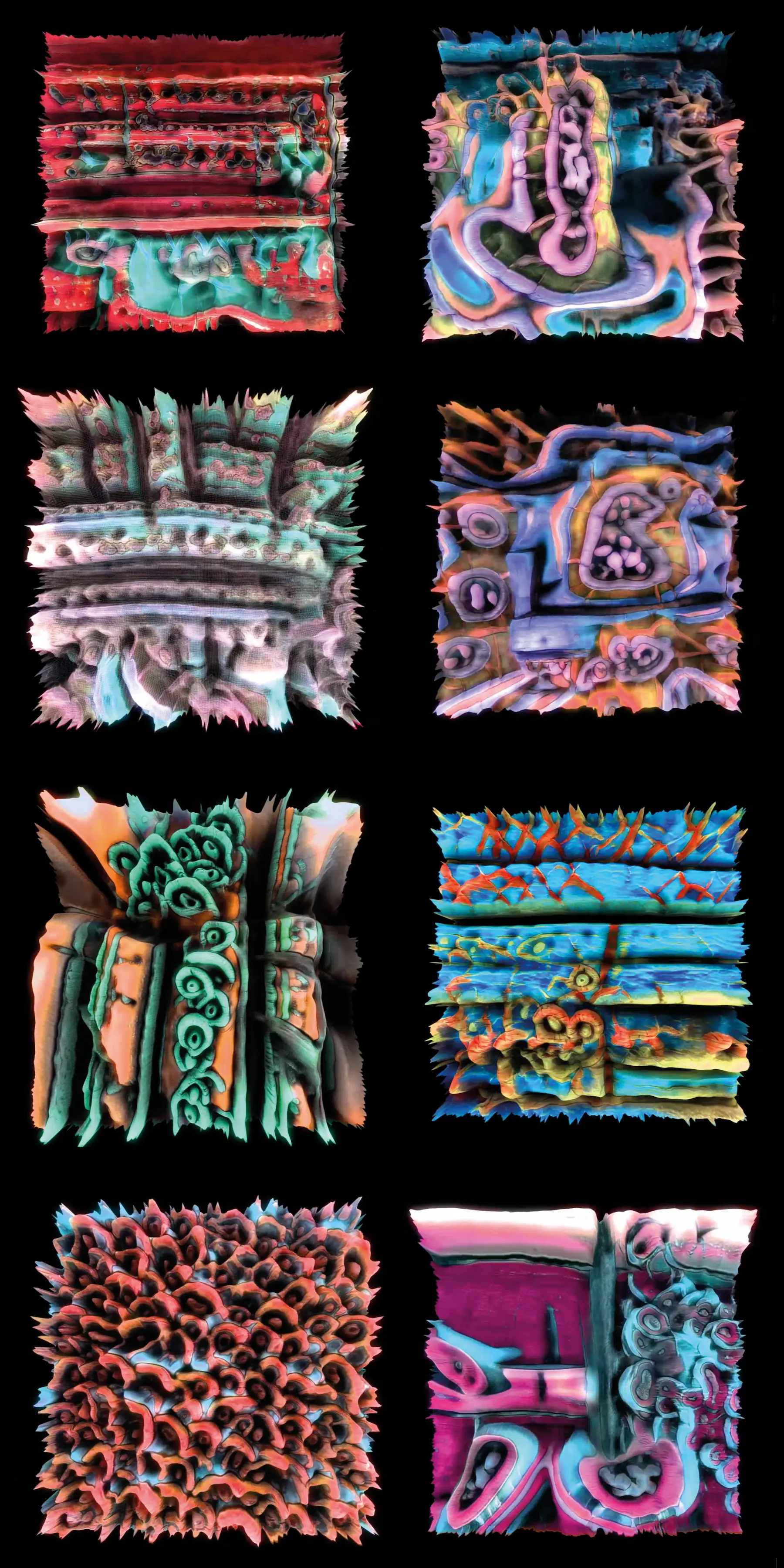
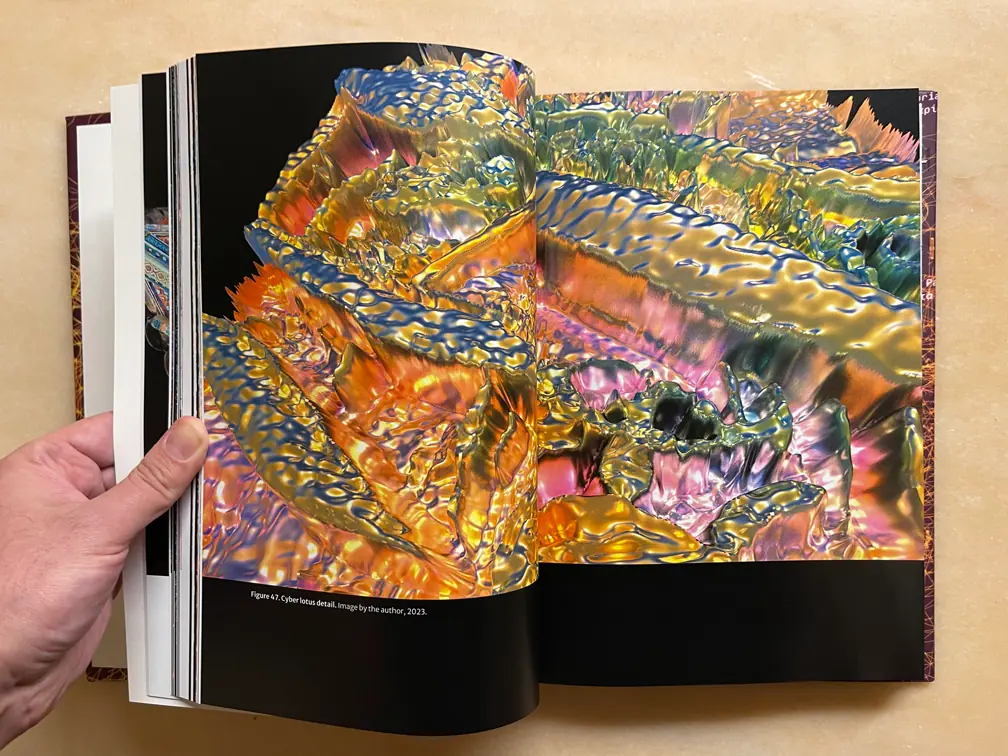
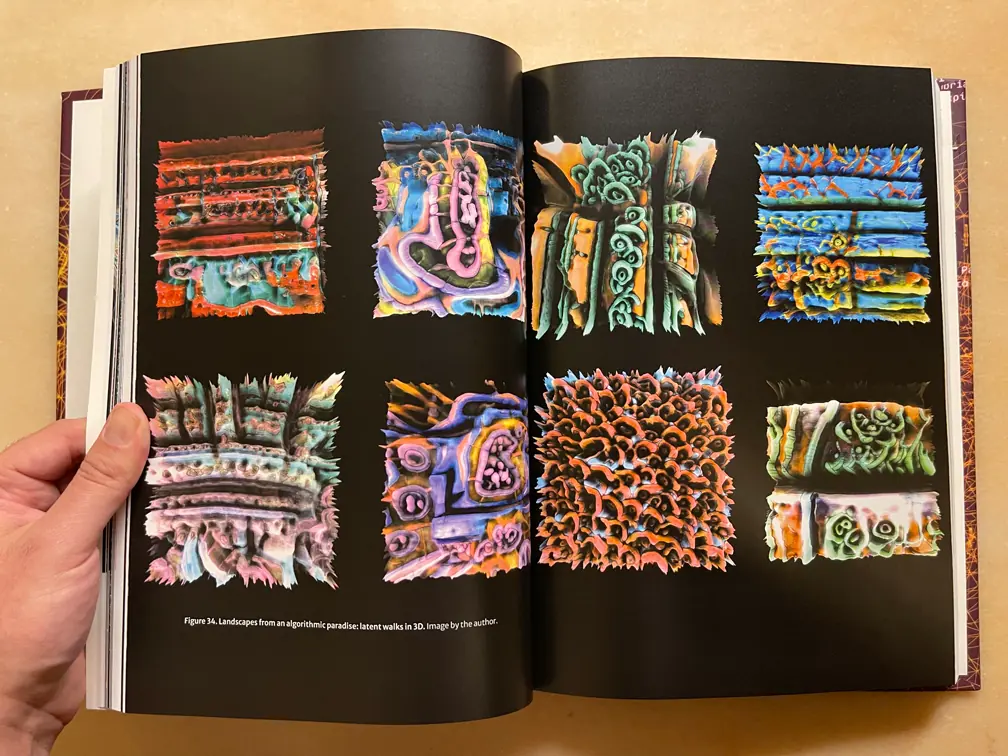
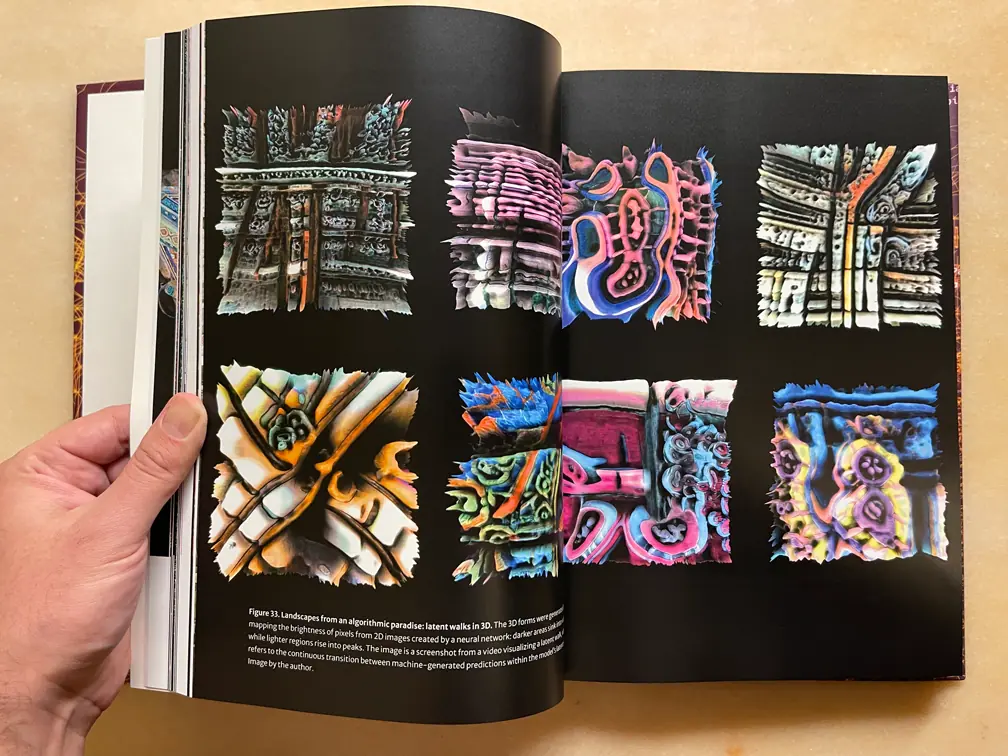
Landscapes from an algorithmic paradise: 3D latent walk visualization mapping neural network image brightness to terrain — darker regions sink into valleys, lighter regions rise into peaks. Screenshot from a latent walk video by Mete Kutlu, 2023
Landscapes from an algorithmic paradise: latent walks in 3D, Mete Kutlu, 2023. The 3D forms are generated by mapping the brightness of pixels from images produced by a neural network: darker regions sink into valleys, while lighter regions rise into peaks. The image is a screenshot from a video visualizing a latent walk, the continuous transition between machine-generated predictions within a model’s latent space.

Dream Pixels

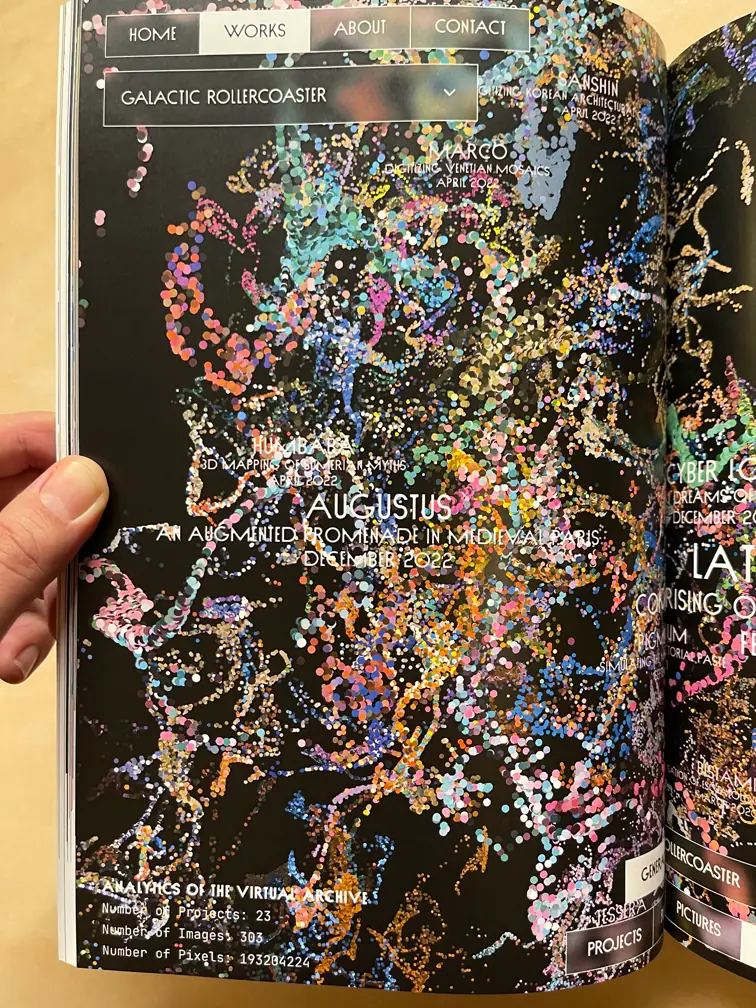
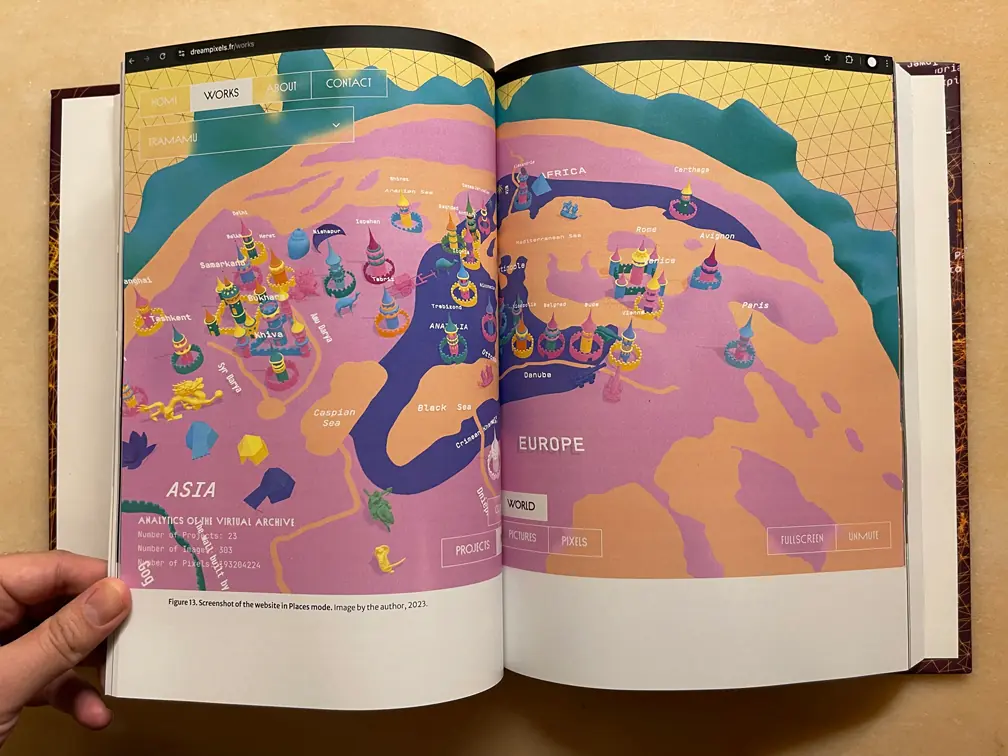
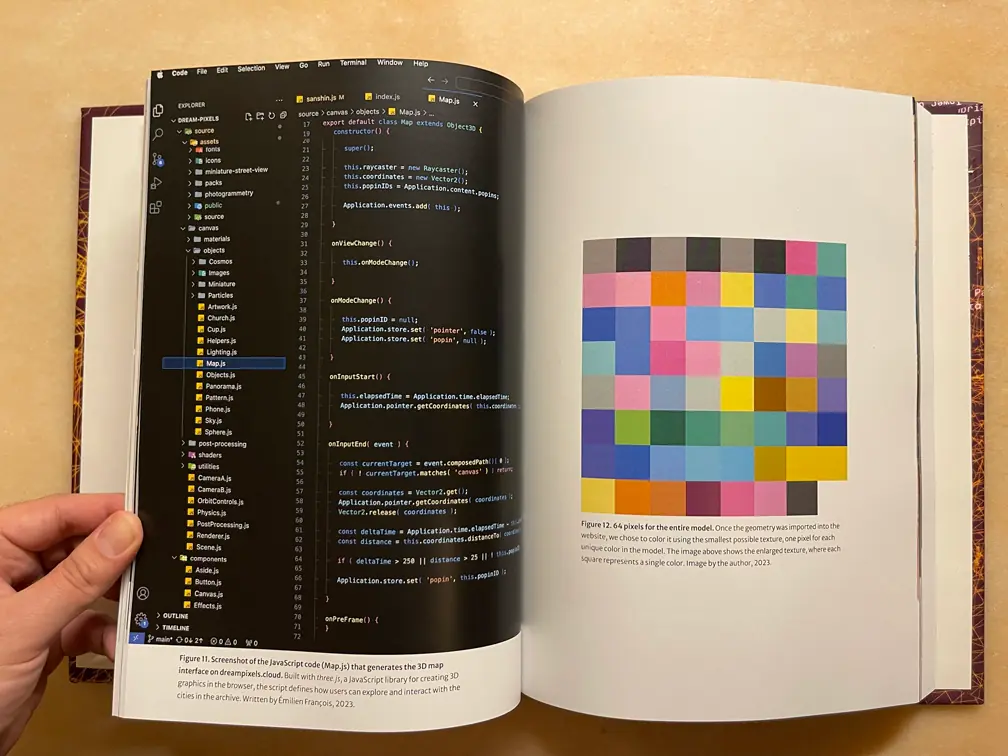
The research concludes with Dream Pixels, an archive for the age of AI. Its interface uses particle simulation to dissolve six years of research into a turbulent timeline of pixels. Structured as a latent space, the interface immerses the user inside the mind of an artificial intelligence while evoking a cosmic journey. Research becomes not an explanation but an exploration, offering a direct experience of knowledge as spatial, nonlinear, and dynamic. The interface functions both as a method of thought and as a poetics of computational perception.
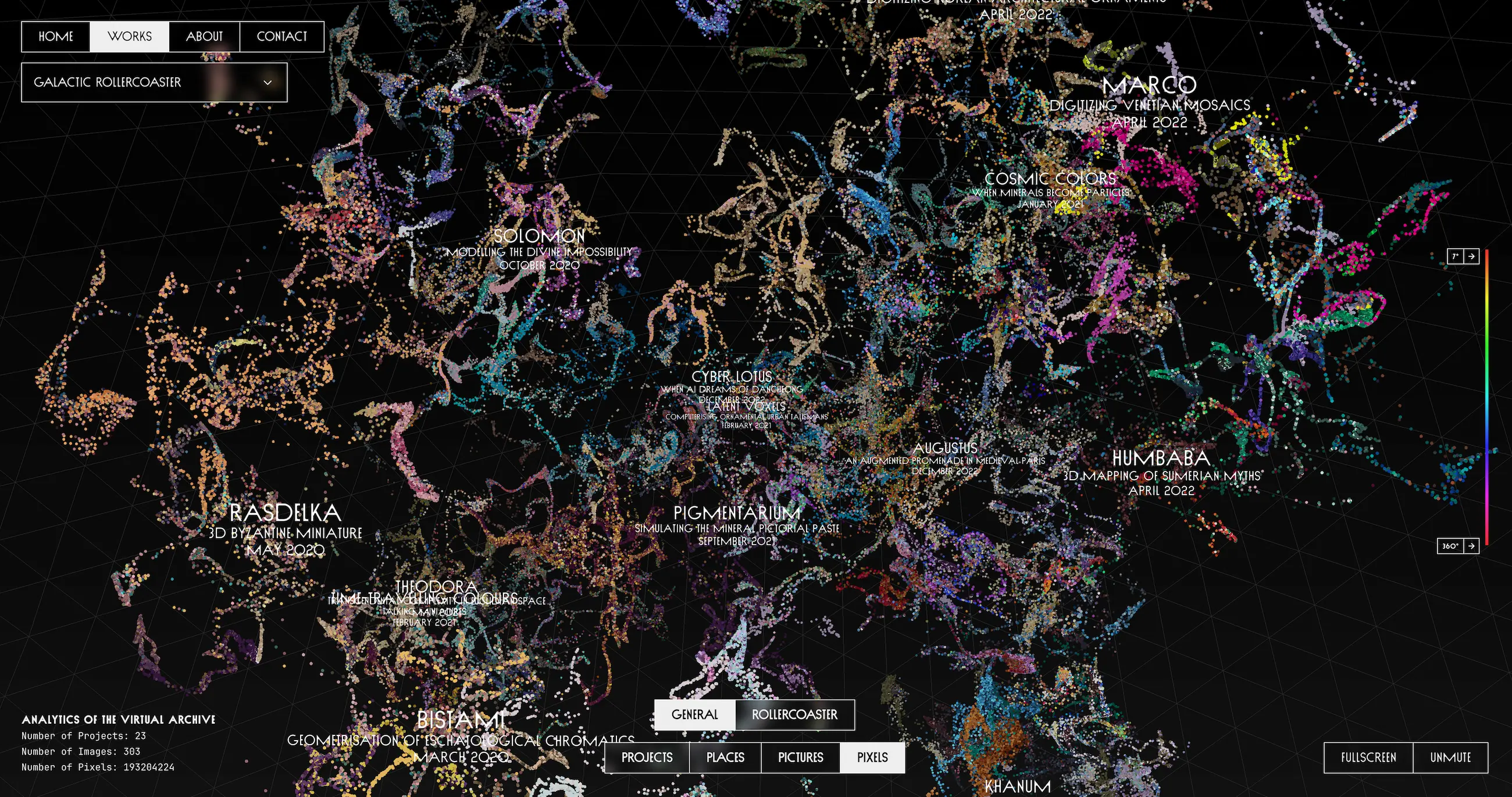
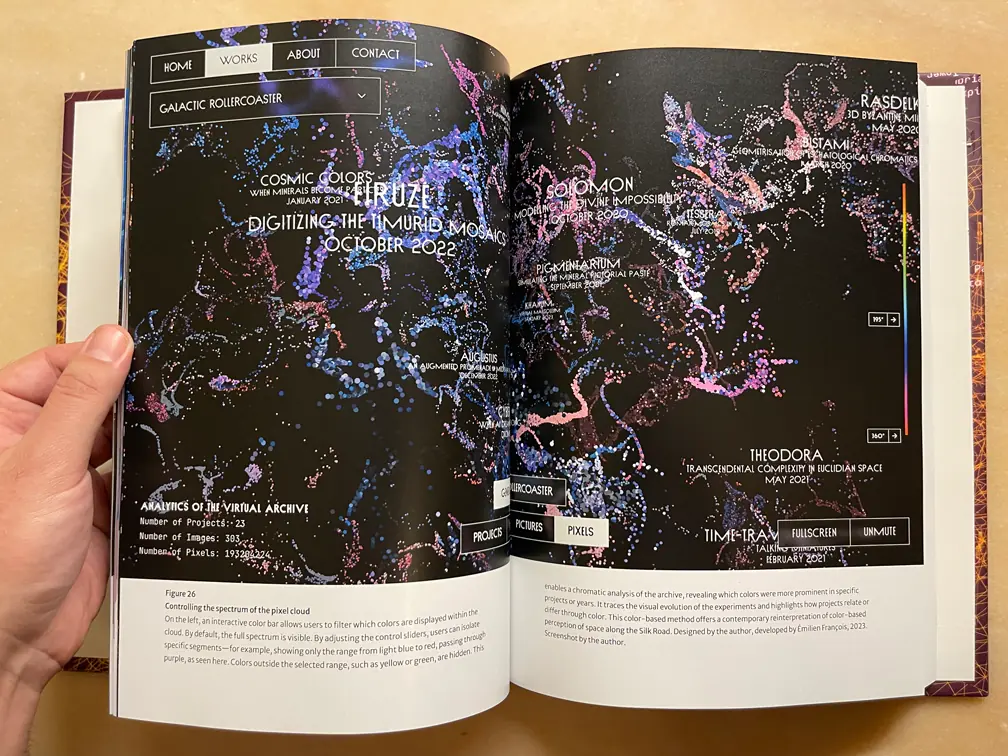
Dream Pixels online archive interface — immersive digital environment translating six years of research into a particle-simulated cloud of pixels, designed as a latent space for the age of AI. Designed by Mete Kutlu and Emilien Francois, 2023

Dream Pixels: a research on the cloud. An online archive for the age of AI, where the cloud becomes not only a place of storage but also an interface and shape of thought. The project explores the cloud as a new cognitive map for post-intelligence, translating research into an immersive digital environment. Designed and developed by Mete Kutlu and Émilien François, 2023, www.dreampixels.cloud.
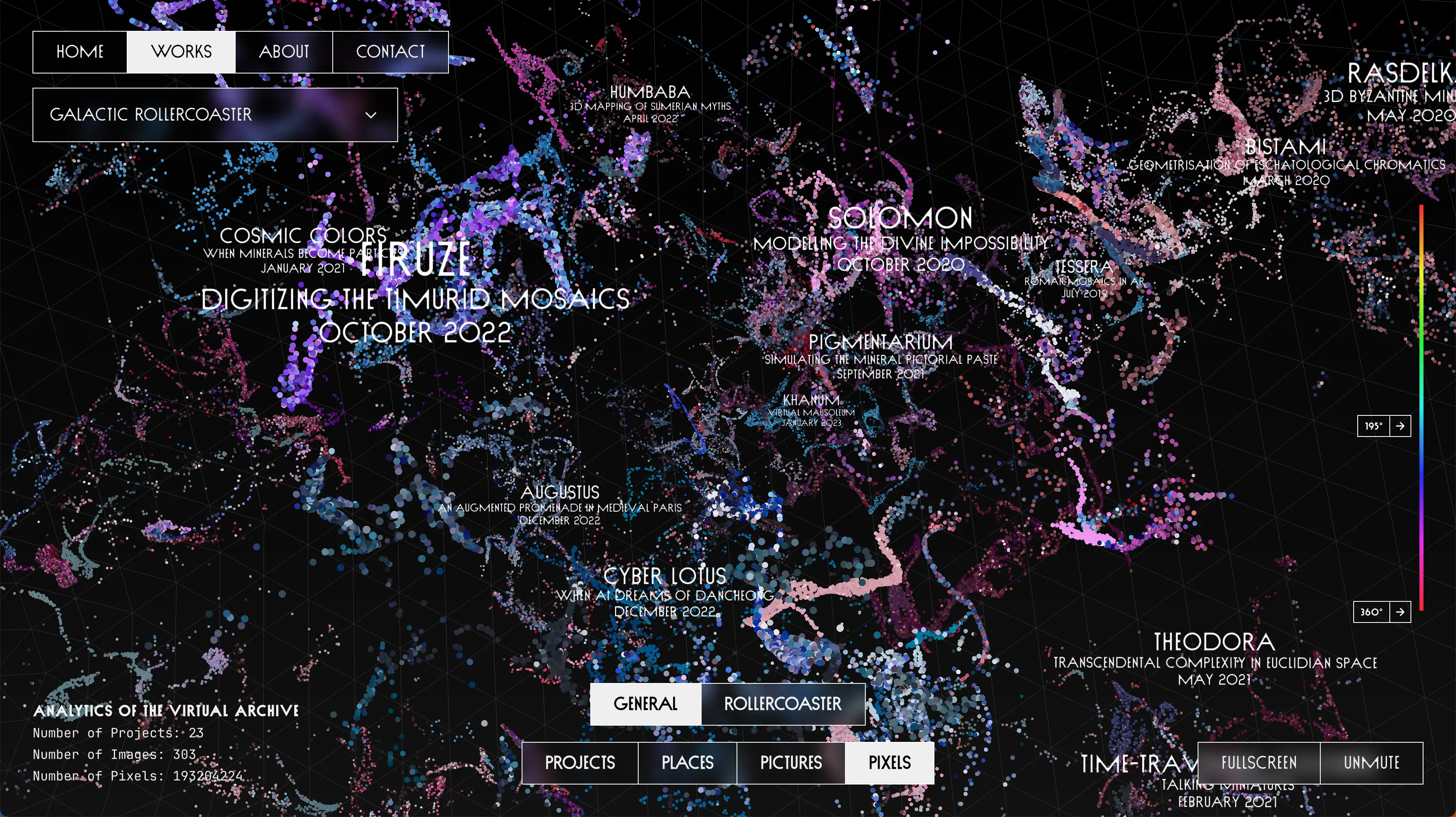
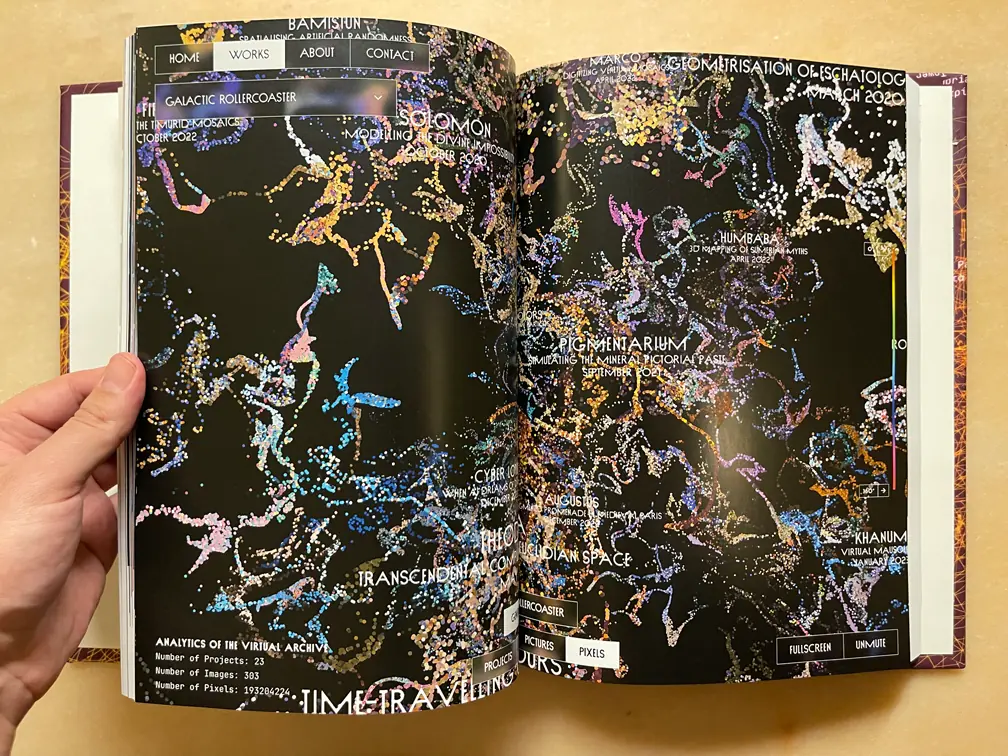
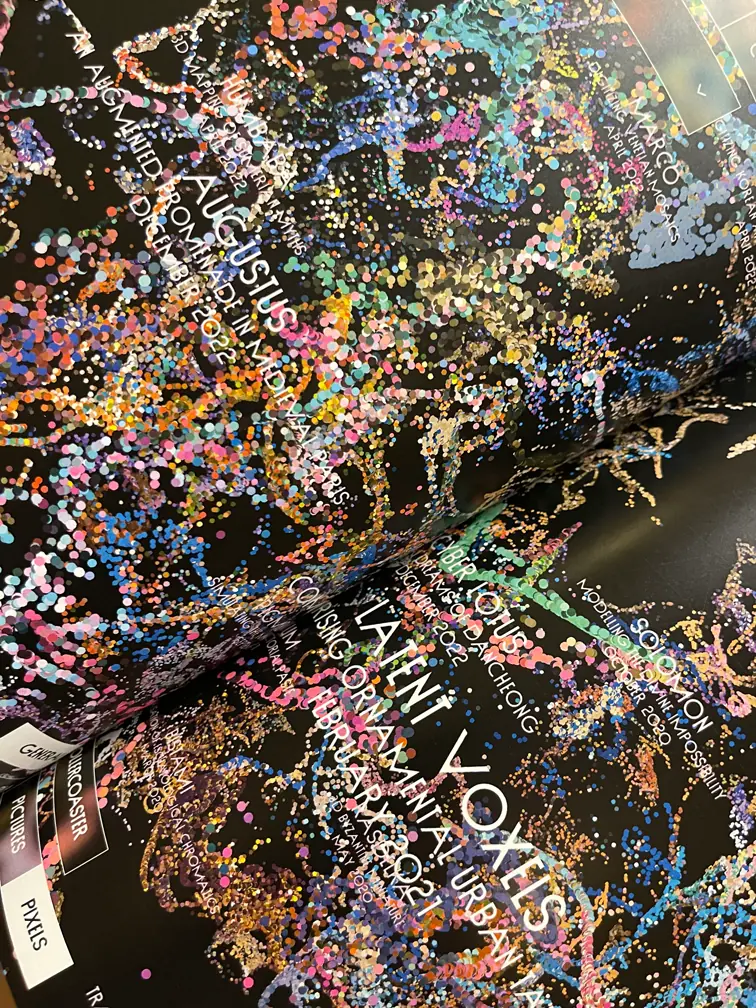
Dream Pixels galactic visualization — colored point cloud where each point represents a pixel extracted from an AI experiment, forming a constellation of data as an immersive map of knowledge. Designed by Mete Kutlu and Emilien Francois, 2023

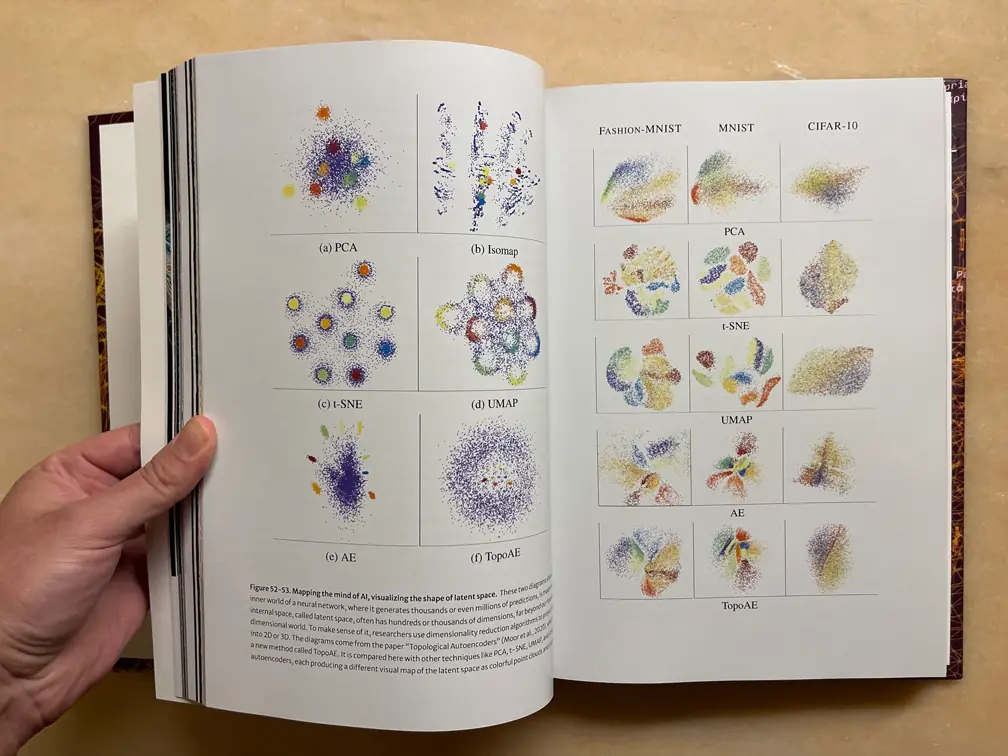
A galactic journey within the neural net. Dream Pixels invites the viewer into the mind of artificial intelligence, known as the latent space. Each colored point represents a pixel extracted from an experiment, forming a constellation of data and an immersive map of knowledge. In this environment, pixels become portals to discoveries. Designed and developed by Mete Kutlu and Émilien François, 2023, www.dreampixels.cloud.

A Cloud Atlas

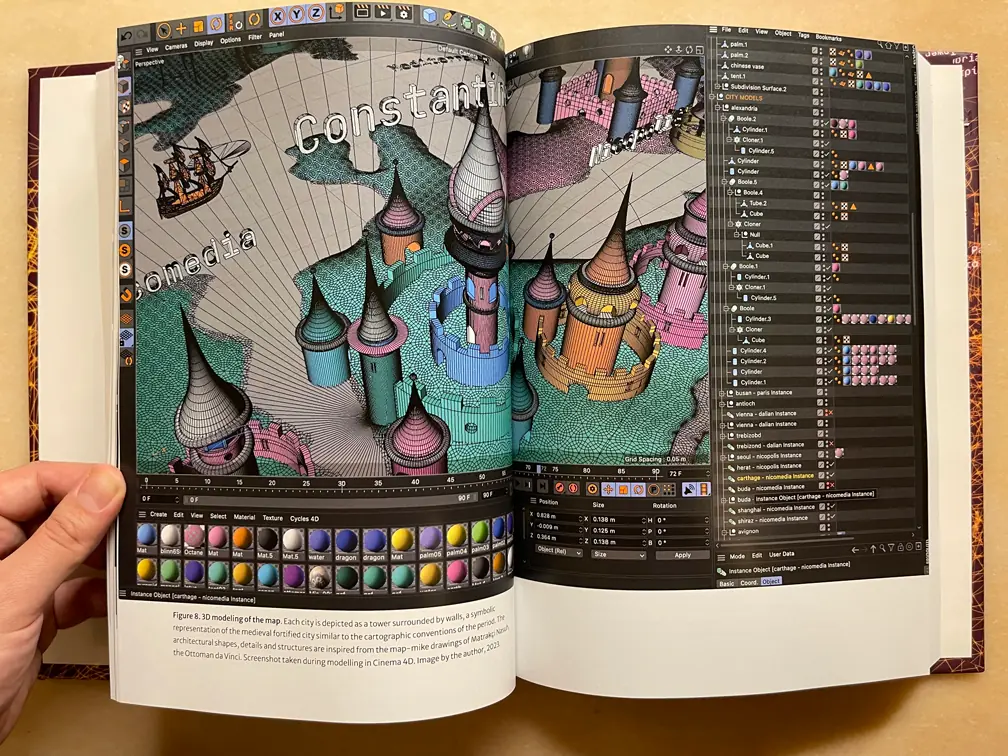
To map this journey, I assemble a Cloud Atlas that connects two worlds: the artisanal and the digital. By placing seventeen cloud figures from both the Silk Road and the age of AI, the atlas traces a cosmopolitan history of civilization. In each period, clouds appear through four domains: images, algorithms, cosmology, and architecture. The artisanal tradition culminates in the symbolic form of the curly cloud, while the digital age leads toward the hypothesis of atmospheric thought. The cosmological imagination of premodern cultures thus anticipated key structures of contemporary computation. The atlas constructs an alternative genealogy of the cloud, revealing how the conceptual architecture underlying our most advanced machines already resonates in the arts and literature of Herat, Samarkand, and Constantinople.
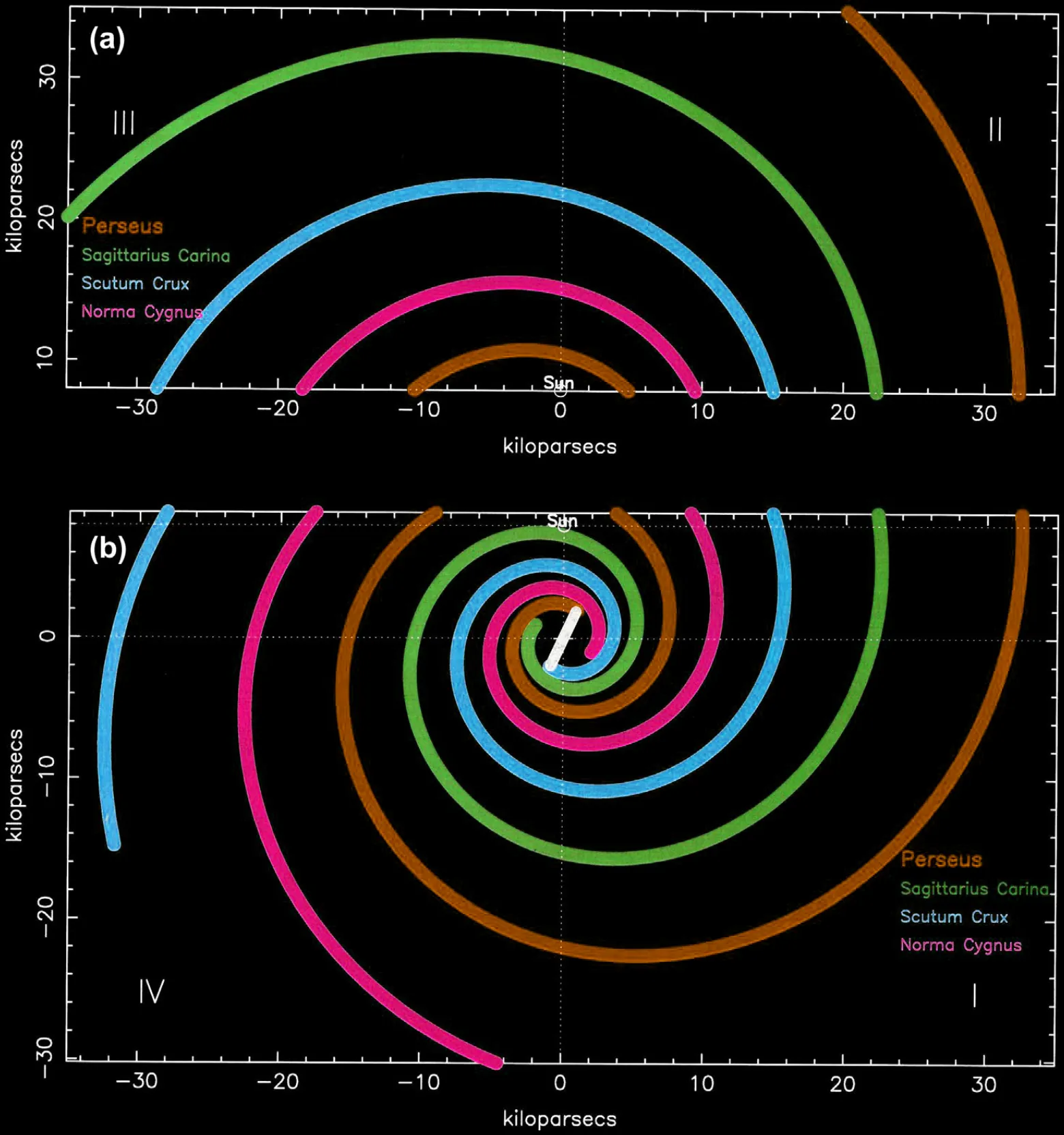
Spiral arm diagram of the Milky Way galaxy — each arm colored differently, divided into the region between the Sun and the Galactic Center (lower) and the Sun and the Anticenter (upper). Diagram by Vallee, Jacques P., 2017

The whirling diagram of the Milky Way. Each spiral arm of the galaxy is represented in a different color. The diagram is divided into two sections: the lower part shows the region between the Sun and the Galactic Center, while the upper part maps the area between the Sun and the Anticenter, the outer edge of the galactic disk. Diagram: Vallée, Jacques P., “A guided map to the spiral arms in the galactic disk of the Milky Way,” 2017.

Spiral of the Cloud

Civilization once unfolded in resonance with the rhythms of the heavens. In the premodern world, cosmology was not one field among many but the mother of all knowledge. Today this cosmic connection returns through a planetary network of computation. This intelligence is not abstract. It is mineral.

Tracing the path from the silica tiles of the Silk Road to the silicon wafers of modern microchips reveals artificial intelligence as an extension of the Earth’s crust. Modern sapiens has become a lithic and atmospheric intelligence. The human story has always been entangled with the cosmic architecture of time. Meteorites forged the first molecular bonds of life. Jupiter and Saturn shaped the climate cycles that enabled the Neolithic revolution. Even extinction and renewal follow the tidal movements of the galaxy. When intelligence is placed within this cosmic horizon, a single evolutionary line appears: from the pulses of deep space to the pulses of the microprocessor. This is the spiral of the cloud.

AI, Our Final Myth

The long history of externalizing dreams into myth reaches its culmination in the age of artificial intelligence. Ideas once confined to legend have become the software of daily life. The soothsayer once spoke with jinns to hear voices from the future. Today that jinn resides inside the machine. We have forged the lamp and placed the spirit within it. The program is our new jinn.

This transformation marks the return of the acheiropoieta, the sacred images “not made by human hands.” Once believed to emerge from divine light, they now appear through electronic light. AI becomes our final myth, a contemporary surface onto which we project our ancient desire for omniscience and our modern fear of obsolescence. It represents the latest stage in a long history of translating existential anxieties into technological systems. As the ancient myth of predetermined fate becomes a technological condition, new strategies of resistance are required. Inspired by Roman, Byzantine, and Sufi traditions, the book imagines forms of survival in an age of total calculation. The path may lie in reclaiming the unknown: cultivating the strange, the cryptic, and the irrational. Like medieval alchemists who concealed knowledge in deliberate obscurity, freedom may lie in obfuscation. To survive the age of the algorithm, we must return to the garden of uncertainty, where nonsense and the primitive remain beyond the reach of calculation.
Scroll to reveal

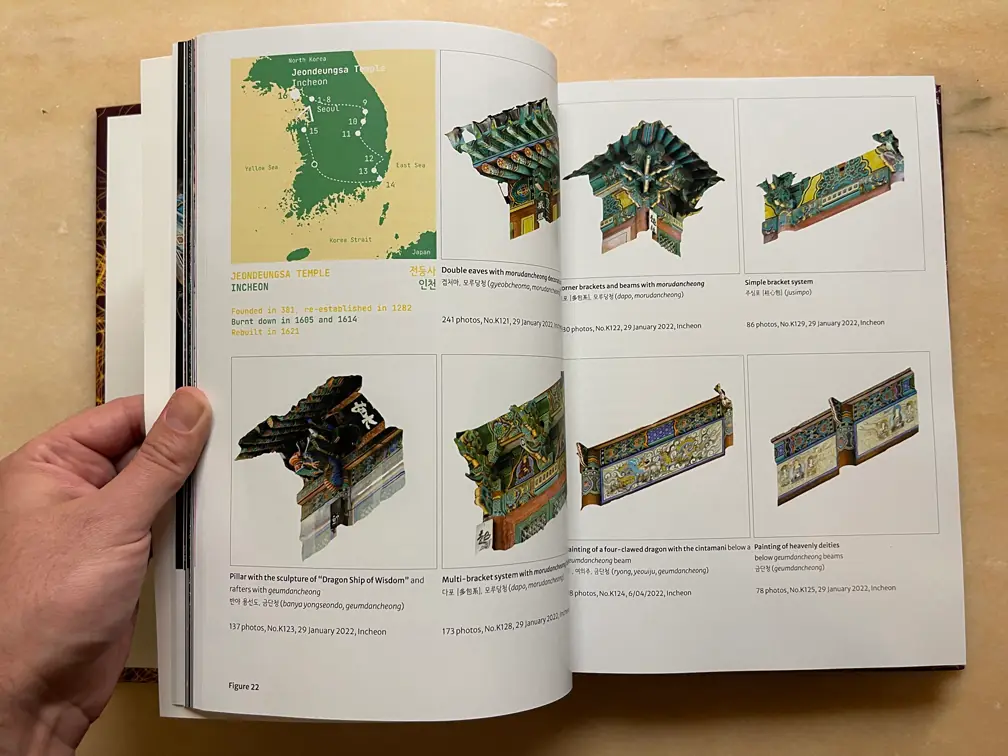
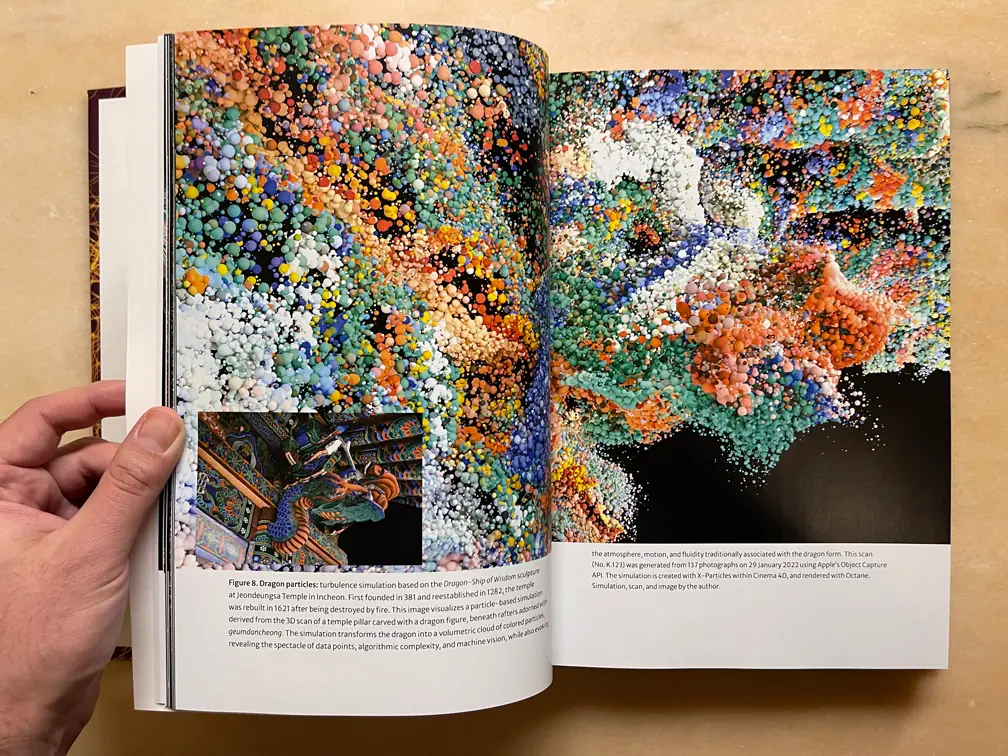
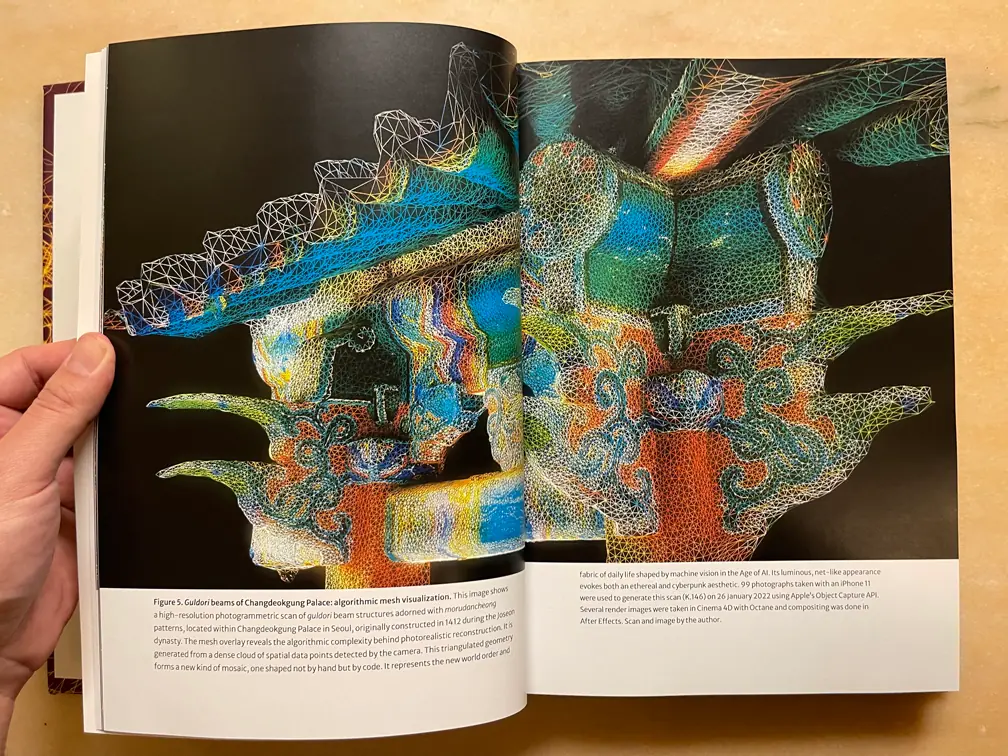
A sculpted wooden dragon figure at Jeondeungsa Temple in Incheon. The decoration represents the Dragon-Ship of Wisdom, a Buddhist metaphor in which the dragon, master of clouds and waters, carries beings across the ocean of illusion toward enlightenment. First founded in 381 and reestablished in 1282, the temple was rebuilt in 1621 after being destroyed by fire. This scan (No. K.123) was generated from 137 photographs taken with an iPhone 11 on 29 January 2022 using Apple’s Object Capture API. Rendered with Cinema 4D and Octane. Scan and image by Mete Kutlu.

Listen to an excerpt
A short reading from Chapter 26 A Cloud Atlas
0:00 / 0:00
Between the grid and the spiral,
between crystal and vapour,
between matter and light,
between Florence and Herat:

The grid is linear, the spiral cyclical;
one brings order, the other turbulence.
One belongs to the philosopher,
the other to the mystic.
The grid lies upon the Earth;
the spiral turns in the Milky Way.

Circles within circles,
spirals within spirals,
motion within motion.
From one scale to another.
For each planet, each star, and each galaxy.
For each quark, each lepton and each boson.

Shabestari had said,
/a hundred blazing suns within each atom/.
Universe within universe,
Stars within stars,
Entire galaxies within a single human.

The future within the past,
and the past within the future.
From silica tiles to silicon chips,
Civilization recorded in a quartz crystal.

Paradox and perplexity,
the operating system of the cosmos.
The universe,
a quantum computer within a black hole.
Running the simulation of itself
on its own event horizon.

From nebular clouds to burning stars,
from atmosphere to life,
from neurons to thinking rocks.

Whether in the blue skies, or
the divine heavens we once imagined,
Or the virtual atmosphere
We constructed with the semiconductor.
Here we enter once again the cloud.

Mete Kutlu, Empire of Clouds, Book V, page 1228, Paris, 2025.
Structures of natural and designed alpha-helical barrels — protein architectures of tightly packed helices, colored by spatial arrangement. Image from Woolfson, D. N., Journal of Biological Chemistry, 2023

Structures of natural and designed α-helical barrels. Different protein architectures composed of tightly packed helices. Coloring indicates the spatial arrangement of the helices. Image: Woolfson, D. N., “Understanding a protein fold: The physics, chemistry, and biology of α-helical coiled coils,” Journal of Biological Chemistry, 2023.

Contents

BOOK V
Synthetic Minds
Data Becomes Space, Thought Becomes Cloud
Digital Media: Machine Learning and Immersive Web Design
Artisanal Media: All Studied Silk Road Paintings and Architecture
24
Nebulous Mind of Artificial Intelligence
From Buddhist Cosmograms to Machine Creativity Hanyang University (South Korea)
25
Dream Pixels Archive
Cosmic Journeys within Neural Clouds
General Conclusion
26
A Cloud Atlas
From Curly Clouds to Atmospheric Thought Paradigm Recap
27
Spiral of the Cloud
Re-entangling Cosmos and Civilization Speculative Conclusion
28
AI, Our Final Myth
Epilogue
Bibliography

A Look inside the Book

Selected spreads from the printed prototype.
Synthetic Minds Book V — page spread 1
Synthetic Minds Book V — page spread 2
Synthetic Minds Book V — page spread 3
Synthetic Minds Book V — page spread 4
Synthetic Minds Book V — page spread 5
Synthetic Minds Book V — page spread 6
Synthetic Minds Book V — page spread 7
Synthetic Minds Book V — page spread 8
Synthetic Minds Book V — page spread 9
Synthetic Minds Book V — page spread 10
Synthetic Minds Book V — page spread 11
Synthetic Minds Book V — page spread 12
Synthetic Minds Book V — page spread 13
Synthetic Minds Book V — page spread 14
Synthetic Minds Book V — page spread 15
Synthetic Minds Book V — page spread 16
Synthetic Minds Book V — page spread 17
Synthetic Minds Book V — page spread 18
Synthetic Minds Book V — page spread 19
Synthetic Minds Book V — page spread 20
Synthetic Minds Book V — page spread 21
Synthetic Minds Book V — page spread 22
Synthetic Minds Book V — page spread 23
Synthetic Minds Book V — page spread 24
Synthetic Minds Book V — page spread 25
Synthetic Minds Book V — page spread 26
Synthetic Minds Book V — page spread 27
Synthetic Minds Book V — page spread 28
Synthetic Minds Book V — page spread 29